
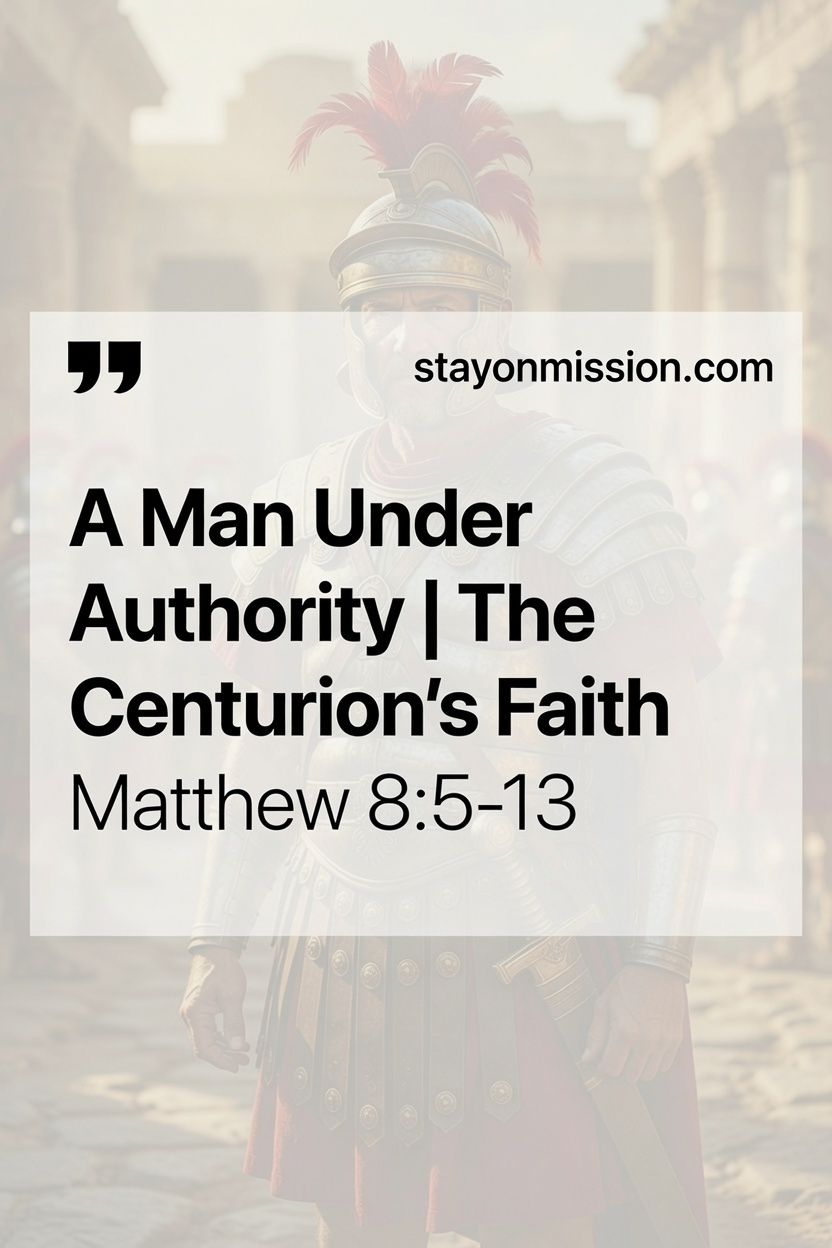
There is a hard thing about authority, and most men only learn it when life forces the lesson. We spend our young years believing the whole point is to claw our way into the driver’s seat and never be told where to go again. We call it freedom. There is a sliver of truth in that, the same sliver of truth in a boy’s certainty that he would be happy if he were only allowed to eat nothing but cake. But it is a small truth, and a small truth gripped too hard hardens into a lie. Today’s passage gives us a view of a leader put over many and the example he shows is one we can replicate.
Matthew 8:5-13 “When he had entered Capernaum, a centurion came forward to him, appealing to him, ‘Lord, my servant is lying paralyzed at home, suffering terribly.’ And he said to him, ‘I will come and heal him.’ But the centurion replied, ‘Lord, I am not worthy to have you come under my roof, but only say the word, and my servant will be healed. For I too am a man under authority, with soldiers under me. And I say to one, “Go,” and he goes, and to another, “Come,” and he comes, and to my servant, “Do this,” and he does it.’ When Jesus heard this, he marveled and said to those who followed him, ‘Truly, I tell you, with no one in Israel have I found such faith. I tell you, many will come from east and west and recline at table with Abraham, Isaac, and Jacob in the kingdom of heaven, while the sons of the kingdom will be thrown into the outer darkness. In that place there will be weeping and gnashing of teeth.’ And to the centurion Jesus said, ‘Go; let it be done for you as you have believed.’ And the servant was healed at that very moment.”¹
Coming off the Sermon on the Mount, Jesus enters Capernaum with His message, His miracles, and His reputation running ahead of Him. A centurion meets Him there, likely an officer of Herod Antipas’ guard with a hundred men under his command, and he is carrying a people problem to which he has no resolution. A servant in his household, one he values dearly, is dying. Luke tells us what Matthew leaves out. The centurion sent the elders of the Jews to carry his request, and they vouched for him without being asked. “He is worthy to have you do this for him, for he loves our nation, and he is the one who built us our synagogue.”² Here was a Gentile officer in a land that was not his own, who had spent his own money to build a house of worship for the very people he was posted among. Whatever else he was, he was no enemy of God’s people.
This soldier is so unexpected. When you look deep at him, you see how much wiser he is than the religious men standing around him. His whole life was built out of authority. He gave orders, and they were obeyed. He took orders, and he obeyed them. And when he came to Jesus about a dying servant, he did the one thing no one else in the story thought to do. He refused to manage the miracle himself. “Only say the word,” he said, “and my servant will be healed,” and then he explained himself the way a soldier would. A man under authority who tells one man to go, and he goes, another to come, and he comes.
He understood both power and authority. Most importantly, recognizing where it was, and was not. He also appreciated that when he gave an order, it could be passed down the ranks, but it would be carried out whether he was standing there to watch it or not. With this, he concludes that the work of the Messiah needs no closer approach than His word. Humbly, he does not ask Him to come and perform for his own gratification or pride. He asks Jesus simply to speak. Real authority is not bound by distance, and to trust the word is to trust the One who gives it.
Matthew Henry put it in a single line in his commentary on this passage. “The more diffident we are of ourselves, the stronger will be our confidence in Christ.”³ The strongest man in the room was the one who admitted he could not fix it but turned to the One who could.
What happens next is bigger than a healed servant, though that is what the man asked for. Jesus hears the request, sees the need behind it, and the first thing He does is marvel. “Truly, I tell you, with no one in Israel have I found such faith.”⁴ Then He gave the order the soldier had been waiting for, and the servant was healed at that very moment.
But Jesus does not stop with the soldier. He widens the frame until it takes in the whole world. He says many will come from east and west to recline at the table with Abraham, Isaac, and Jacob, while the sons of the kingdom are thrown into the outer darkness. The outsider with no birthright is seated, and the insider who assumed his place was guaranteed is put out in the cold. The seat at that table works the way every seat in this story works. You do not seize it by rank, by pedigree, or by how long your family has sat in a pew. You receive it by belief in the One and only savior, or you do not receive it at all.
Two meaningful leadership applications today. The first is the way the centurion showed he cared. He spent his reputation, his money, and his time on one dying servant, and he treated the man the world counted as property as though he were family. His culture gave him every excuse to do nothing, but his conscience refused it. How do you answer when the people under your command are the ones falling into life’s desperation?
The second is where he ran. When every fix he knew had failed, his foundation was revealed. His belief and faith came not from his own abilities but from an authority higher than his own. When the impossible lands on your house, where do you go first? Is Jesus your last resort or first?
The centurion leader provides an example for every leader. Even leaders must understand where their abilities are limited and where their authority is derived. The sooner we hand control to the One in power and ready our talents to perform His mission, the sooner we will achieve the best results.
What will you do when trials come to your household?
How will you care for those within your influence?
Stay on Mission
He was a Gentile military officer who commanded about a hundred men, stationed at Capernaum, most likely an officer in the forces of Herod Antipas rather than a Roman legionary, since Galilee had no standing Roman garrison at the time. Luke 7 adds that he loved the Jewish people and had funded the local synagogue.
Because the centurion understood authority. As a man who gave and received orders, he knew a command from real authority is carried out whether the one giving it is present or not. He applied that to Jesus and asked only for the word, trusting it to heal at a distance. Jesus said He had not found such faith in all Israel.
It means the centurion did not need Jesus to come to his house or perform a ritual. He believed the spoken word of Christ carried full authority over the sickness, with no nearer approach required. It is a picture of faith that trusts the command without managing how it will be answered.
Yes. Jesus told him to go, and the servant was healed at that very moment, exactly as the centurion had believed.
Matthew has the centurion approach Jesus directly, while Luke 7 records that he first sent the Jewish elders and then sent friends. There is no contradiction. Matthew tells it the short way, following the ancient principle that what a man does through his messengers he is said to do himself. Luke simply gives the fuller mechanics.
He means the kingdom is not secured by bloodline or pedigree. Outsiders with no birthright, pictured by this Gentile soldier, will be seated at the table with Abraham, Isaac, and Jacob, while those who assumed their place was guaranteed are shut out. The seat is received by faith, or it is not received at all.
Two things. First, he cared enough for one servant to spend his reputation, money, and time, treating a man the world counted as property as family. Second, when his own solutions failed, he turned to a higher authority instead of gripping the wheel harder. Real leadership knows where its power ends and where it is derived.
Footnotes
- Matthew 8:5-13 (ESV).
- Luke 7:4-5 (ESV).
- Matthew Henry, Commentary on the Whole Bible, Volume V: Matthew to John, on Matthew 8:5-13. Public domain.
- Matthew 8:10 (ESV).


Leave a Reply