
Author: Rod Reasen II
Jesus handpicked an ordinary team and commissioned them to an extraordinary mission. This series for leaders breaks down how we can view our stewardship responsibility in team building.
My phone rang. My wife’s voice was speaking quietly on the other end. “Honey. Don’t get upset. Let him explain it to you.”
“Uh, explain what?” I said.
“Just be patient with him when you get home; he’s already upset enough on his own.”
Still no explanation of what I’m not supposed to be upset about. So I came home expecting something to be ruined. A mower in the lake. A garage door is broken. Maybe windows shattered or a dead animal.
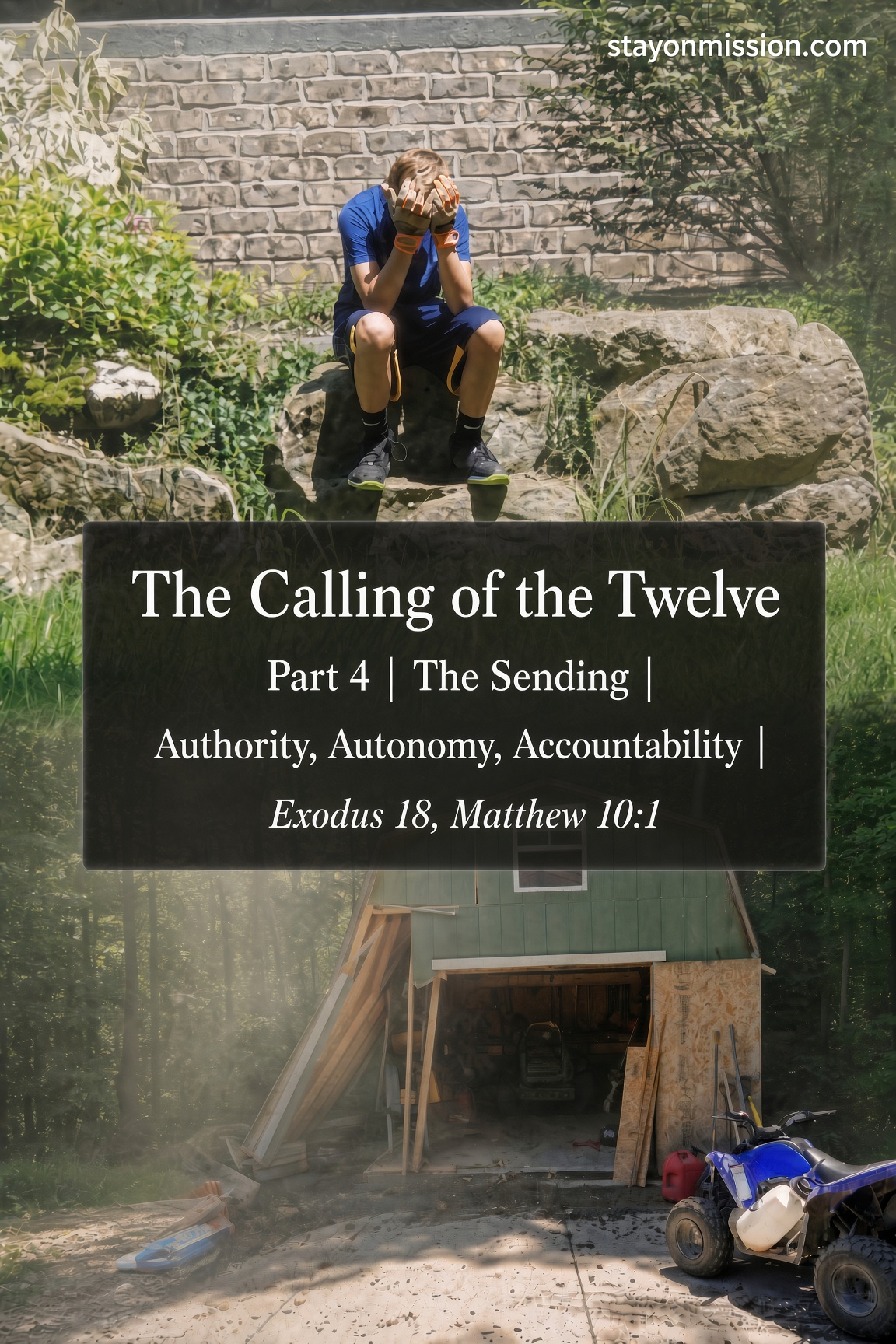
Honestly, my mind would never have guessed what I’d see. Our shed was still standing, but with two missing walls.
My son, then 11, had been learning to operate our skid loader and had gotten pretty good at helping me move dirt and trees around the yard. That weekend, a storm had blown three trees completely across our driveway. We managed to get the drive opened up, but there were weeks of work to be done, chaining long logs to the machine and pulling them back to be cut and split for firewood.
Without my prompting, but with lots of watching me and training, he drove the skid loader down the drive, chained a large branch to it, and began pulling back to the fire pit. He was taught well. Well, except for what sometimes experience has to teach you.
The tree’s branches extended much wider than the drive, caught the edge of the shed door, and pulled the front and entire left side clean off! It was a miracle that the shed was still standing. Fortunately, my wife gave me that warning that day, and we all ended up laughing at it and taking on a family project to repair the barn.
And that leads us into the final part of this leadership series. You’re ready to hand over the reins and see if you and they are ready. The moment in every leader’s life when the work leaves their hands.
It is almost easier to see in our kids because they have only the experiences we give them. But with fellow leaders on the team, trust has to be given and then built as success happens. The exponential benefit of leadership.
That moment is where Matthew 10 and Exodus 18 converge. Time to send the called to the mission.
“And he called to him his twelve disciples and gave them authority over unclean spirits, to cast them out, and to heal every disease and every affliction.”1
Greek has an ordinary word for sending. Pempo shows up eighty-one times in the New Testament, and it simply means to dispatch someone somewhere. Jesus does not use it here. The word behind apostle is apostello, and it is the official one, carrying a specific mission, delegated authority, and the equipping to accomplish it.2
He did not send them. He commissioned them. An important distinction.
Three things travel with a person when you send them out that way. Two of them you hand over. The third cannot be handed over at all, and that is the whole point of this final lesson in this series.
The first is Authority. The word Jesus uses is exousia, and it does not mean raw force. It means delegated right, from a root that carries the sense that a thing is permitted.3 Where dunamis is the ability to do something, exousia is the entitlement to do it. A soldier may have strength in their hands, but they have authority because of the flag on their shoulder.
Matthew has already used that exact word of Jesus twice. After finishing the Sermon on the Mount, the crowds marveled that He taught “as one with authority” and declared that His authority extended from heaven to earth.4 Now the same noun describes what He hands to twelve men who had done nothing to earn it.
Jethro’s proclamation to Moses had the same structure and passing of authority. Each appointed man stood over thousands, hundreds, fifties, or tens, sized to what he could actually carry, and inside that tier, he represented Moses.5 The leaders were not passing messages up the line and waiting for rulings. They were carrying Moses’ own authority to discern the matter and decide it.
Leaders love the delegation part but often have a hard time allowing others to make the full decision. But that is where the seat’s real power kicks in. Duplication of aligned efforts. Innovating beyond your own thinking and elevating your position to do more.
Now, notice what was never handed over. They received authority over unclean spirits and over every disease. They received no authority to convert anyone. Nothing in the grant touches a human heart. They could clear obstacles and authenticate the message, and the one thing that actually mattered stayed in His hand.
The second thing is Autonomy. Mark tells us He sent them out two by two, and that was not a buddy system.6 Under the law, a matter had to be established by the testimony of two or three witnesses.7 A single man’s account could be dismissed on procedure. Two could not. Making the message admissible before a court of law. But even more, giving each other strength along the journey.
Then He turned them loose. No supervision, no approval chain, no way to reach Him between towns.
Jethro’s men operated the same way. Let them judge the people at all times, every great matter they shall bring to you, but any small matter they shall decide themselves.8 The default was decide, not ask, and there was a defined path for the few things that had to come back up.
But real autonomy always has edges. Jesus didn’t send them out randomly. He pointed them explicitly in one direction first. Go nowhere among the Gentiles, He tells them, and enter no town of the Samaritans, but go rather to the lost sheep of the house of Israel.9
Twelve men, twelve tribes, one nation. That was what they could carry at that stage of their development. He would hand them more later, but He sent them first to the house of Israel.
Jesus goes on to give clear direction, explains what to do when listeners don’t respond, and does something we often miss or avoid. He tells these men exactly what the price of leadership will cost them.
Behold, I am sending you out as sheep in the midst of wolves, so be wise as serpents and innocent as doves.10 Notice the verb. He commissions them and warns them in the same sentence.
Then He gets specific. They will be delivered over to courts and flogged in the synagogues, dragged before governors and kings. Brother will deliver brother over to death, and a father his child. You will be hated by all for my name’s sake.11 A disciple is not above his teacher, and if they called the master of the house Beelzebul, how much more will they malign those of his household.12
The warning came in during commissioning, and well before they left. Not after they were committed. Not once they were three towns out with nowhere to go back to.
A leader who sends people into difficulty without naming the difficulty has not commissioned anyone. They have recruited them under false pretenses, and now their integrity and leadership are jeopardized.
Which brings us to the third leg of the stool.
Accountability was never given away, because it could not be. It is what connects the mission to the leader. Leave it out, and you have neither a learning cycle nor alignment. What you end up with is silos of execution.
Most of us treat accountability as something that flows up to the boss, which reduces it to a reporting line and a recurring meeting on the calendar. That is not what Jethro described. He did not say, “Find men who will answer to Moses.” He said find men who fear God and hate a bribe.13 The most important vertical line for a leader is to God Himself.
Think of it as a flow. The leader who stays connected to God carries responsibility downward to the people they lead. When the upward line is right, authority arrives from above, passes through a man who is himself under authority, and lands on people who can feel the difference.
When that upward line breaks, the leader is no longer walking in step with his own Leader. He does not announce it. He may not even notice it. But he starts serving himself, and his decisions begin to reflect his self-serving desires.
And once it happens, a small trickle can quickly become a raging river. One man serving himself becomes drift at every level beneath him. People take their cues from the seat. Not from the statement on the wall. Slowly, the organization simply stops pointing where it said it pointed, and the mission drift is often costly to repair. That makes accountability the magnetizing line that holds the three together, and the one a leader can never delegate.
For both the leader and the follower, accountability is ownership of your decisions and outcomes, measured against the mission rather than the org chart. When done right, authority, autonomy, and accountability become the framework for sound leadership.
My son and I both learned a lot about each other and the training that day. Fortunately for us, the failure turned into a repairable lesson and a fun story.
So what do you do with this?
If you lead, first check your relationship with God. Remember the steps you follow have others behind them. The closer your walk with Him, the closer theirs will be as well. Then, find one decision you have been holding that somebody has already been trained to make, and hand it over completely, including the right to decide it differently than you would. Write down what is in bounds and what is out before they go. Provide specificity where needed and tell them the hard part before they leave, not after.
If you are waiting on a seat rather than sitting in one, authority will eventually be given to you, and autonomy will follow. Neither one is yours to arrange.
Accountability is different. You build it in private, long before anyone offers you anything, and it is the only one of the three you can start on today. Remember, trustworthy people are the ones who get chosen.
Authority. Autonomy. Accountability.
Next lesson, we will take a detour into each of the chosen. Twelve ordinary men on an extraordinary mission. What can we each learn from their lives?
Two questions to sit with today.
First, what are you still holding that somebody on your team has already earned, and what is the real reason you have not let it go?
Second, when nobody is watching at all, who are you accountable to, and would the people around you answer that question the same way about themselves?
Stay on Mission
In Matthew 10, Jesus called His twelve disciples, gave them authority over unclean spirits and every disease, and sent them out to preach that the kingdom of heaven was at hand. He gave them specific instructions on where to go, what to carry and what to do when a town rejected them, and then He told them plainly what the mission would cost before they left.
Both Greek words mean to send, but they are not the same. Pempo is the general term, used simply for dispatching someone somewhere. Apostello is the official word, suggesting authoritative sending and carrying a reference to equipment. Mission, delegated authority and the equipping to accomplish it are all inside the one verb, which is why it stands behind the word apostle.
Exousia means delegated right or authority, from a root meaning it is permitted or lawful. It is different from dunamis, which is inherent power or ability. A soldier has strength in his hands, but he has authority because of the flag on his shoulder. Matthew uses exousia of Jesus before using it of the twelve, which shows He was handing them His own authority.
Mark 6:7 records that He sent them out in pairs. Under the law, Deuteronomy 19:15 required a matter to be established by the testimony of two or three witnesses, so a single man’s account could be dismissed while two could not. The pairing made their message admissible, and it also gave each man strength along the journey.
In Matthew 10:5-6 He directed them first to the lost sheep of the house of Israel. It was a defined scope sized to what the twelve could carry at that stage of their development. The scope later widened, when the same men were told in Matthew 28:19 and Acts 1:8 to go to all nations and to the end of the earth.
In Matthew 10:16 Jesus tells the twelve He is sending them out as sheep among wolves, and to be wise as serpents and innocent as doves. He then describes courts, floggings, governors and family betrayal. The point is that He named the cost before they left rather than after they were committed, which is what separates a commission from a recruitment under false pretenses.
In Exodus 18:21, Jethro did not tell Moses to find men who would answer to him. He told him to find men who fear God and hate a bribe. That places accountability upward to God before it is ever a reporting line to a boss. Authority and autonomy can be handed to someone, but accountability cannot, which is why it has to be present in a person before they are ever chosen.
Footnotes
- Matthew 10:1 (ESV). Unless otherwise noted, Scripture quotations are from the English Standard Version.
- Greek apostello, Strong’s G649, contrasted with pempo, Strong’s G3992. Thayer notes that pempo is the general term, while apostello suggests official or authoritative sending and includes a reference to equipment.
- Greek exousia, Strong’s G1849, from exesti, it is permitted or it is lawful. Contrast dunamis, Strong’s G1411, inherent power or ability.
- Matthew 7:29 and Matthew 9:6.
- Exodus 18:21 (ESV).
- Mark 6:7 (ESV).
- Deuteronomy 19:15 (ESV). See also Deuteronomy 17:6 and Numbers 35:30.
- Exodus 18:22 (ESV).
- Matthew 10:5-6 (ESV).
- Matthew 10:16 (ESV).
- Matthew 10:17-18 and 10:21-22 (ESV).
- Matthew 10:24-25 (ESV).
- Exodus 18:21 (ESV).


Leave a Reply