
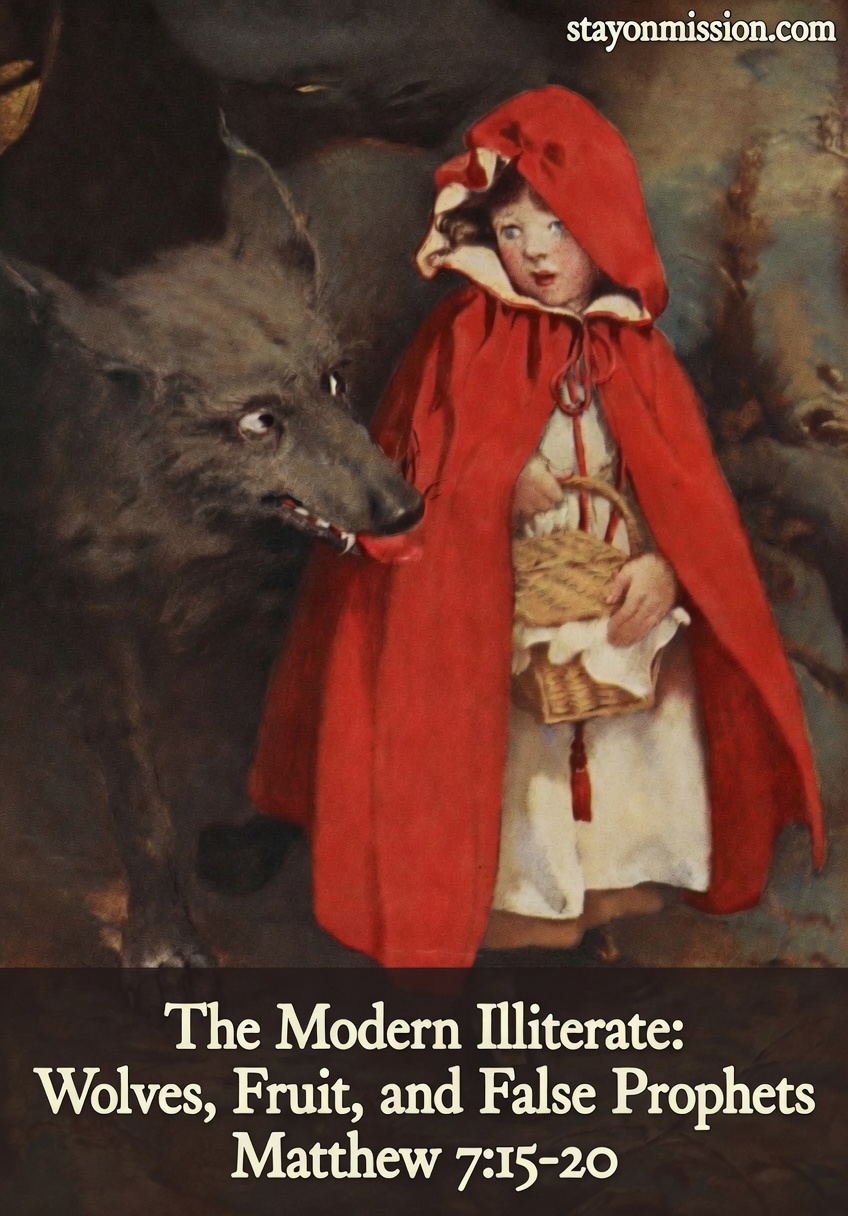
The story of Little Red Riding Hood walking to her grandmother’s house and meeting a “friendly” wolf along the way is most commonly told as a children’s bedtime story. A folk tale designed to drive home a moral warning about how easily the innocent are deceived.
What most people do not realize is how old it is. The earliest known version was written by a cleric named Egbert in his book The Well-Laden Ship between 1010 and 1026, nearly a thousand years ago.¹ For most of its life, the tale was far darker than the one we tell our children now. In Charles Perrault’s 1697 version, the wolf eats both the grandmother and the girl, and no one comes to save them.² Perrault wrote it down alongside the tales that became Sleeping Beauty, Cinderella, and Puss in Boots.
But like many strong warnings, this tale eventually lost its teeth. The version most people know today came from the Brothers Grimm, whose “Rotkäppchen” sends in a huntsman to cut the wolf open and bring the grandmother and the child out alive.³ Every generation has reshaped the ending to match what it could bear, but the middle never changed. The wolf gets in because he does not look like a wolf.
While the old folk tale carries a sharp warning for young children, the warning Jesus levies carries eternal weight.
“Beware of false prophets, who come to you in sheep’s clothing but inwardly are ravenous wolves. You will recognize them by their fruits. Are grapes gathered from thornbushes, or figs from thistles? So, every healthy tree bears good fruit, but the diseased tree bears bad fruit. A healthy tree cannot bear bad fruit, nor can a diseased tree bear good fruit. Every tree that does not bear good fruit is cut down and thrown into the fire. Thus, you will recognize them by their fruits.” Matthew 7:15-20 (ESV)
The crowd in Jesus’ day, much like the earliest hearers of this folk tale, was largely illiterate. Reading was a privilege of the few, and access to written Scripture was scarce.⁴ They depended on the literate to tell them the truth. So Jesus hands them a test that needs no scholarly prosecution, no scientific analysis, no outside opinion. He uses fruit.
Since moving south, we have had the pleasure of planting fruit trees we could never have grown in the colder north. We are still learning. But when a yellow fruit ripens on one of our trees, and we cut it open, the sour juice tells the truth, no matter what we thought we planted. The tree does not lie about itself.
The threat here is far more serious than planting the wrong fruit tree out of ignorance. These false teachers have their own interests in mind. The Greek word harpax, behind “ravenous,” means rapacious, grasping, self-serving.⁵
The wolf is not in the fold to feed the sheep. He is there to feed on them.
They can cover their tracks for a season. They can even tell the truth here and there to keep the disguise believable. But the truth they speak in passing is not the test. The direction they are leading you is the test.
Listen to Jeremiah.
“Thus says the Lord of hosts: ‘Do not listen to the words of the prophets who prophesy to you, filling you with vain hopes. They speak visions of their own minds, not from the mouth of the Lord. They say continually to those who despise the word of the Lord, “It shall be well with you”; and to everyone who stubbornly follows his own heart, they say, “No disaster shall come upon you.” Jeremiah 23:16-17 (ESV)
The mark of the false prophet in Jeremiah is the comfortable message. He is there to assure peace where there is no peace, to bless the sin you do not want to leave, because blessing it serves him and keeps you following. The man who only ever tells the flock what it wants to hear is the man Jeremiah is condemning, and the man Jesus is warning against.
In contrast, Galatians 5:22-23 hands us the full produce aisle of genuine spiritual fruit: love, joy, peace, patience, kindness, goodness, faithfulness, gentleness, self-control. A genuine teacher will bear the marks of the Spirit’s work. When you walk into a grocery store’s fresh fruit aisle, you instantly become an inspector without thinking about it. You turn the fruit in your hand. You look for blemishes, bugs, bruising, any reason to put it back. As you should. That is the same judgment call Jesus is calling us to when inspecting what we hear.
Astoundingly, we have advantages the hillside crowd never had. The Spirit indwells us. The full canon of Scripture is on our shelves and in our pockets. Study tools that a fourth-century church father could not have dreamed of are one search away. And yet, we let others tell us what God said. Like getting your groceries delivered and finding the less inspected item… The person who has access to the Word, with study materials only a question away, and does not use them, is no different than the illiterate one on the hillside being led astray.
Jude describes the false teachers as fruitless trees in late autumn, twice dead, uprooted (Jude 12-13). The image of the barren tree marked for destruction is exactly the tree of Matthew 7:19, the one cut down and thrown into the fire. A warning aimed primarily at the false prophets. However, and even more pointedly, it can also be aimed at you and me. We have to be careful fruit inspectors of what we take in, and we also have to look honestly at the fruit we ourselves are producing and sharing. That tempting morsel may look right to share, but is it?
Each day, we have access to a mega store of information larger than any of us can digest. If we do not inspect carefully, we could end up eating from the dumpster and call it dinner. Worse, we may feed it to the people who follow us.
Beware of false prophets. Inspect the fruit.
Stay on Mission
Reflection:
- When you evaluate a teacher, a leader, or a message, what do you actually weigh first, the polish or the fruit?
- Run the fruit test on your own life this week. What is the last season actually producing, and what does that say about the root?
Footnotes:
¹ Earliest written version traced to Egbert of Liège, Fecunda ratis (The Well-Laden Ship), c. 1010-1026. Medievalists.net, “The Earliest Little Red Riding Hood Tale.” Scholarly trace via Jan M. Ziolkowski’s work on the Latin poem within Egbert’s text.
² Charles Perrault, “Le Petit Chaperon Rouge,” in Histoires ou contes du temps passé (Paris, 1697). Encyclopædia Britannica, “Little Red Riding Hood.”
³ Jacob and Wilhelm Grimm, “Rotkäppchen” (“Little Red Cap”), in Kinder- und Hausmärchen (Berlin, 1812; final form in the 7th edition, 1857). D.L. Ashliman folktexts archive, University of Pittsburgh.
⁴ Scholarly estimates place rural literacy in first-century Roman Palestine well under ten percent, and possibly as low as three percent for the Jewish population. See William V. Harris, Ancient Literacy (Cambridge, MA: Harvard University Press, 1989), and Catherine Hezser, Jewish Literacy in Roman Palestine (Tübingen: Mohr Siebeck, 2001).
⁶ Featured image: “Little Red Riding Hood,” illustration by Jessie Willcox Smith (1863–1935), from A Child’s Book of Stories by Penrhyn W. Coussens (Duffield & Company, 1911). Public domain. Smith’s major illustrated works, published between roughly 1902 and 1925, are firmly in the public domain in the United States under current copyright law, which holds works published before 1929 in the public domain. A Child’s Book of Stories is available in full scanned form at the Library of Congress, the Internet Archive, and Project Gutenberg. Title overlay and watermark added by Stay on Mission.


Leave a Reply