
Matthew 5:5 “Blessed are the meek; for they shall inherit the earth.1” (KJV)
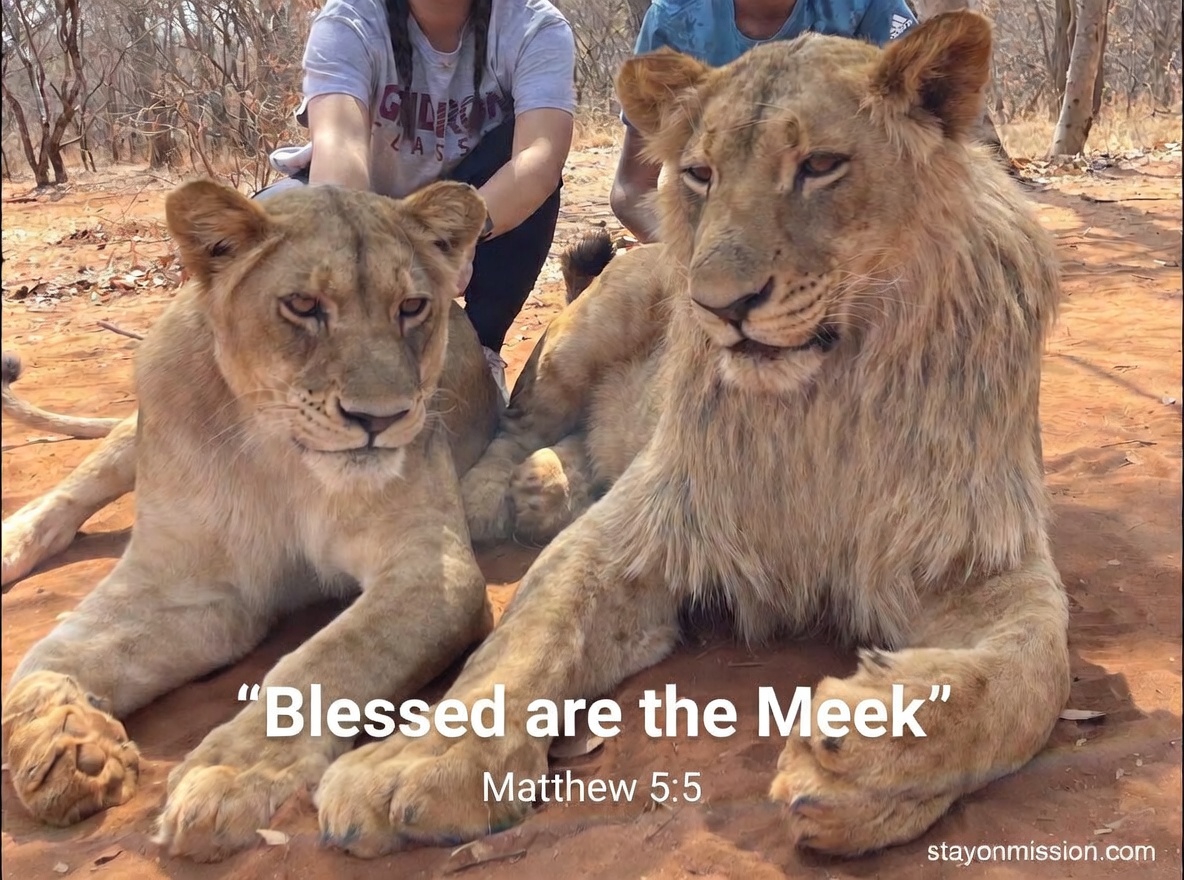
While visiting Zambia, our family had the opportunity to do a “walk with the lions” tour. A remarkable and exhilarating experience where you sit with two-year-old lions and walk with them, holding their tails. When first instructed to do so, we looked at our guide with some apprehension, but he assured us, stick in hand, that it would be okay. As we sat and then walked with the lions, tail in hand, I asked why they used two-year-old lions for the walk. His reply: “Because at two and a half, they will eat you.”
Power, fully intact. Fully controlled.
That is the picture Jesus is painting when He says blessed are the meek.
Meekness is not an attribute that rises to the top of most leadership lists. But consider its antithesis: uncontrolled anger, arrogance, and pride. Hubris that answers to no one. Those qualities don’t make the list of healthy leaders either. What we actually admire, even when we can’t name it, is strength that knows when to move and when to hold. A warrior who is dangerous and disciplined. A leader who has enough power to destroy and enough character not to.
That is praus, the Greek word behind “meek.” It was used to describe a war horse trained for battle. Not a weak horse. Not a passive horse. A powerful animal whose strength had been brought under the will of its rider. The horse loses nothing in the breaking. It gains a mission.
Philippians 2:5–8 shows us what that looks like in the flesh:
“Let this mind be in you which was also in Christ Jesus, who, being in the form of God, did not consider it robbery to be equal with God, but made Himself of no reputation, taking the form of a bondservant, and coming in the likeness of men. And being found in appearance as a man, He humbled Himself and became obedient to the point of death, even the death of the cross.6” (NKJV)
The Son of God, before whom angels bow, through whom galaxies were spoken into existence, borrowed a manger, borrowed a boat, borrowed a tomb. He had every right and waived every one. Not because He was weak. Because He was on mission. That is meekness at its purest: the greatest power in the universe, fully submitted to the will of the Father.
Those lions in Zambia carried the same raw capacity for destruction they would have at any age. What their handlers had developed in them was not the absence of power. It was power brought under authority. We walked beside them. We held their tails. And they let us.
We carry power too. Our words can set fire to a room or breathe life into a broken person. Our actions either build people up or leave wreckage behind. The question is never whether we have power. The question is who is holding the reins.
In the progression of the Beatitudes, the first three form a sequence that cannot be skipped. Poverty of spirit comes first. You see your bankruptcy before God. Mourning follows. You grieve it. Then meekness, the posture that results when both of those have done their work. C.H. Spurgeon put it plainly: “Blessed are the meek is a benediction which no man reaches till he has felt his spiritual poverty, and mourned over it.”
Meek is not weak. But you cannot manufacture it. You cannot fake niceness and call it meekness. Niceness is personality. Meekness is what happens after God has broken you and rebuilt you under His authority. The root has to be there first.
Without it, great power consumes itself. It becomes useless for the kingdom, or worse, dangerous to it.
The war horse is no less of an animal because it submits to the rider. It becomes what it was always made to be.
Where do you need to submit your will to the Father today?
Where do your actions or attitudes need meekness right now?
Stay on Mission


Leave a Reply