
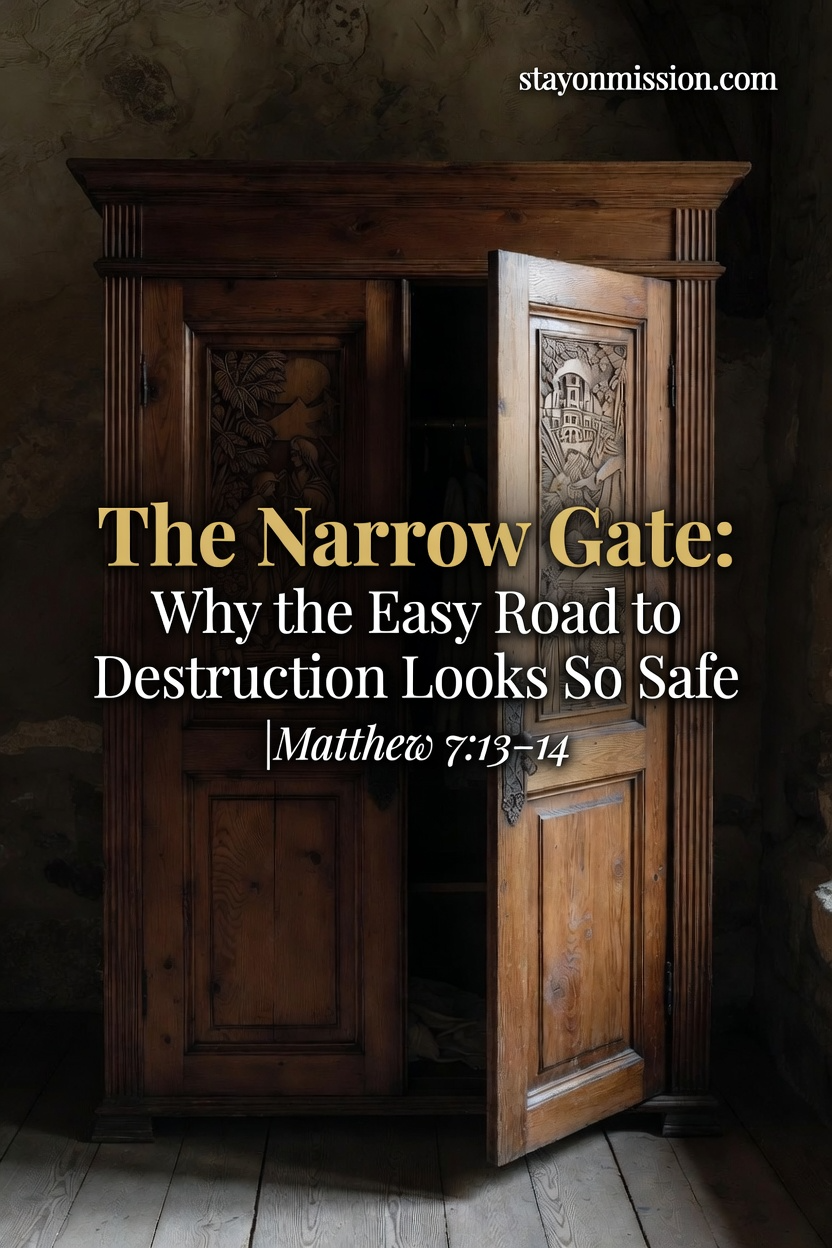
In The Lion, the Witch and the Wardrobe, C.S. Lewis paints a picture of an obscure, dusty wardrobe that Lucy stumbles into during a game of hide and seek. She pushes her way gently through the coats until she falls backward into the snow, opening to a majestic, unseen world. Lewis always claimed the Narnia series was more “supposal” than allegory, but a reflection of truth can be seen in that short passage found here in Matthew.
Matthew 7:13-14 “Enter by the narrow gate. For the gate is wide and the way is easy that leads to destruction, and those who enter by it are many. For the gate is narrow and the way is hard that leads to life, and those who find it are few.”
The journey of faith is anything but glamorous, and it can be downright terrifying. Joseph was thrown into a pit, Daniel into a lion’s den, and hosts of believers since have been burned, sawn in two, and beheaded for simply walking toward the narrow gate. Foxe’s Book of Martyrs and The New Book of Christian Martyrs are full of them.
If you’re an American, you are candidly spoiled, rich by any worldwide standard, and likely have faced only minor scratches comparatively for your faith. A friend once told me about his father saying goodbye to a Russian underground church pastor after a Bible smuggling trip in the 1990s. In his farewell, he told the pastor, “I will pray for you in your persecution and poverty.” To which the Russian pastor responded, “And I will pray for you in America with your materialism and distractions.” That man faced execution if he was caught, and he knew our trouble ran deeper than his.
Lewis said what we all think in Surprised by Joy. “I was soon (in the famous words) altering ‘I believe’ to ‘one does feel.’ And oh, the relief of it! From the tyrannous noon of revelation I passed into the cool evening twilight of Higher Thought, where there was nothing to be obeyed, and nothing to be believed except what was either comforting or exciting.”¹ Notice what he calls it. Relief. Freedom. The rebellion sells itself as the hard, brave, active choice, when the truth is the exact inverse. The broad road is the surrender to ease. It is the road you end up on when you stop swimming and let the current carry you.
The verse starts with the word ‘enter’ and conveys urgency about the decision. And why the urgency? Because, as Proverbs 14:12 warns, “there is a way that seems right to a man, but its end is the way to death.”² The distractions are not harmless. They are deadly, and they are dressed up to look like nothing at all.
The Greek word for narrow is stenos, and the root carries the sense of obstacles standing close together or a space constricted and tight. Some lexical work traces it to a root meaning to groan, the way a man groans under pressure. It is the same word the Old Testament reaches for in places of real distress, as when the angel of the Lord stands in a narrow place where Balaam’s donkey can turn neither right nor left.
When I was a teenager, my youth group went spelunking, crawling on our bellies through the tightest part of a cave for about a hundred yards. Deep into the crawl, the ceiling and the floor pressed so close together that I could not turn my head, and right there, at the tightest point, the guide had us all turn off our lights. It was a surreal and disturbing moment. We made it out of the cave with torn clothes and scrapes from the rocks, but not until we crawled back through that same opening. That’s the work and pressure we will face.
There is another option this verse shares, but with extreme warnings about where it leads. The way to destruction is broad, from a Greek word that appears only once in the New Testament, with parts pointing to freedom, openness, and wide-open spaces. The road to destruction does not advertise itself as cramped or miserable. It feels spacious and relaxed. There is room for a man and all his baggage, entrapments, and pleasures.
That is exactly why the broad road is so dangerous, because it does not look like the road to destruction. John MacArthur put it plainly.
“The way that is broad is the easy, attractive, inclusive, indulgent, permissive, and self-oriented way of the world. There are few rules, few restrictions, and few requirements. All you need do is profess Jesus, or at least be religious, and you are readily accepted in that large and diverse group. Sin is tolerated, truth is moderated, and humility is ignored. God’s Word is praised but not studied, and His standards are admired but not followed.”³
The broad road is not only the road of the open sinner. It is wide enough to hold a man who says the right words, knows the right songs, and is admired by the right people, and is still walking the whole time toward destruction. The easy believism, cultural, small-c Christian.
But the gate that leads to eternal life in heaven is narrow. John 10:9 Jesus says, “I am the door. If anyone enters by me, he will be saved,”⁴ and “I am the way, and the truth, and the life. No one comes to the Father except through me” John 14:6.⁵ The narrowness is not a disguise or trap, but it is exclusive. Philippians 2:9–11 states, “Therefore God has highly exalted him and bestowed on him the name that is above every name, so that at the name of Jesus every knee should bow, in heaven and on earth and under the earth, and every tongue confess that Jesus Christ is Lord, to the glory of God the Father.”⁶
So which road are you on?
Maybe you have never come through the narrow gate, never bowed your knee to Jesus, the one and only High Priest whose perfect blood is the atonement for your sin. So many will wait, telling themselves there is always tomorrow, while the current carries them along the broad and comfortable road. Do not wait. The gate is open. Will you come through Him today? Or maybe you are already His, and you have drifted, lulled by the materialism and distractions the Russian pastor saw so clearly in us. Set not your affection here. Stay alert. Get back on the narrow road.
Lucy pushed through the coats and fell backward into a world her brothers and sister could not yet see, a world of snow and lamplight and a King on the move. Lewis spent seven books describing the wonder of it. And as glorious as Narnia is on the page, it is only a shadow, a faint and borrowed sketch of the real thing. The world being built on the other side of the narrow gate is no invented country. It is the kingdom of the living God, prepared for everyone willing to leave their baggage at the door and come through the one Door who is Christ Himself.
Deuteronomy 30:19, “I call heaven and earth to witness against you today, that I have set before you life and death, blessing and curse. Therefore choose life, that you and your offspring may live.”⁷ Choose, and choose now, because He knows exactly what the two roads in front of us lead to.
Which road are you traveling?
Which gate have you entered?
Stay on Mission
Footnotes
1. C. S. Lewis, Surprised by Joy: The Shape of My Early Life (London: Geoffrey Bles, 1955).
2. The Holy Bible, English Standard Version (Wheaton, IL: Crossway Bibles, 2025), Pr 14:12.
3. John MacArthur, The MacArthur New Testament Commentary: Matthew 1–7 (Chicago: Moody Press, 1985).
4. ESV, Jn 10:9.
5. ESV, Jn 14:6.
6. ESV, Php 2:9–11.
7. ESV, Dt 30:19.


Leave a Reply