
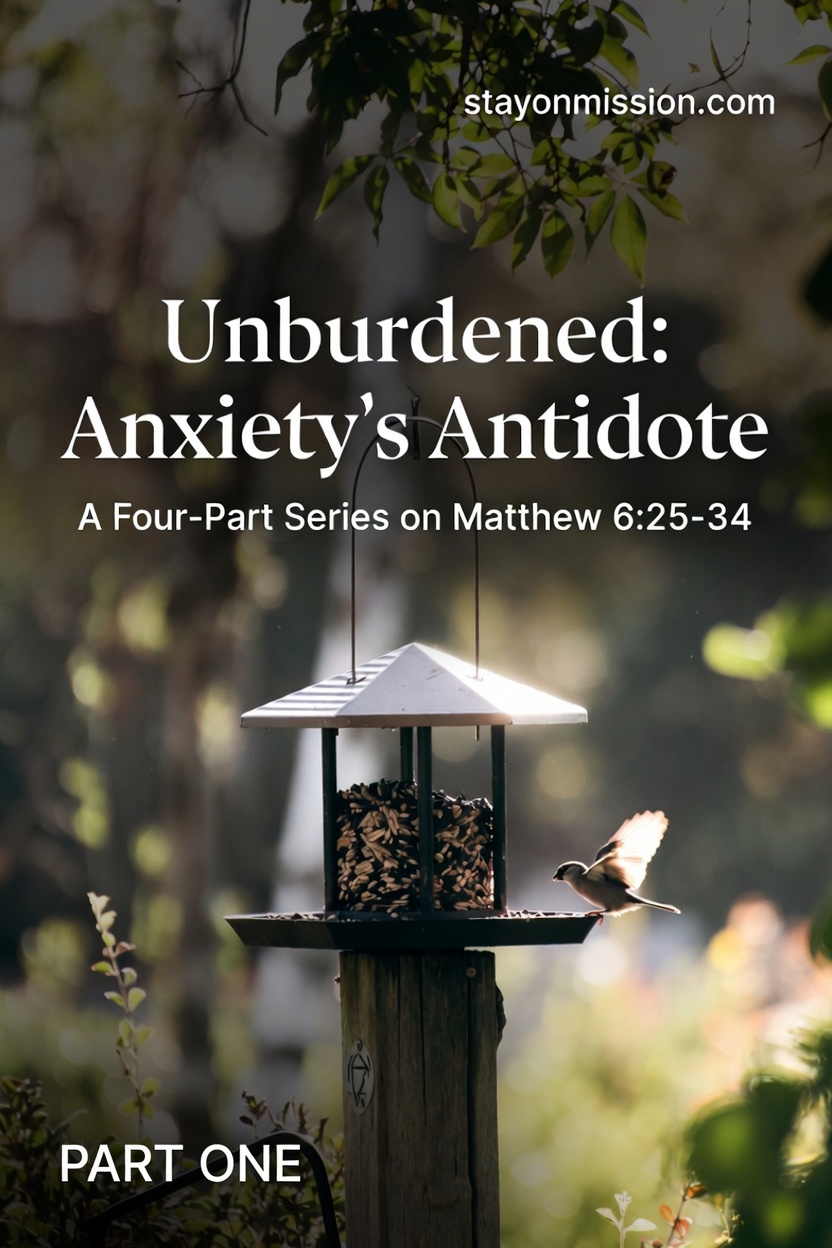
Unburdened: Anxiety’s Antidote A Four-Part Series on Matthew 6:25-34
Part 1: Look at the Birds Matthew 6:25-27
In 2008, in the middle of the recession and bank bailouts, everything tightened up fast. Credit markets were nearly frozen, and financial institutions became rigid almost overnight. Fear was everywhere, paralyzing growth and sending shudders into the market.
I was running a financial services and insurance practice and had decided to buy a building and expand operations the year before. Looking back, our timing may not have been the best, but it was exactly what God would use to grow me in trusting Him deeper.
Even though we had never been late on a payment, the banks started putting pressure on us and began threatening to call our loan. They were looking for any relief, and somehow we were supposed to provide it. That was an incredibly stressful season. I can still remember coming to my office early one morning with that weight on my shoulders, opening my Bible, and landing on this very passage.
That text hit differently when the pressure was real, but it was clear my Father had a message for me, and He does for you as well.
*”Therefore I tell you, do not be anxious about your life, what you will eat or what you will drink, nor about your body, what you will put on. Is not life more than food, and the body more than clothing? Look at the birds of the air: they neither sow nor reap nor gather into barns, and yet your heavenly Father feeds them. Are you not of more value than they? And which of you by being anxious can add a single hour to his span of life?”*¹
Matthew 6:25-27 (ESV)
Therefore.
Wherever we see that word, we pause to ask, “What is it there for?” In this case, placed in the middle of the Sermon on the Mount and directly following the teaching on treasure, the eye, and the impossibility of serving two masters, therefore is more than a soft transition. It is the logical conclusion. Our choice between mammon and Christ is the leverage point on the weight of anxiety. The heart that has settled the master question has settled the worry question. The heart that has not will be pulled apart by the same forces that pulled it apart in verse 24.
The Greek word for anxious in verse 25 is merimnao.² The root of the verb means to divide. The picture is the mind torn between competing concerns, the heart at war with itself, the man whose attention cannot rest because it is pulled toward multiple concerns at once. The same verb is used by Paul in Philippians 4:6 in a direct command: “Be anxious for nothing.” It is the same condition James diagnoses in James 1:8, describing the double-minded man as unstable in all his ways. Anxiety is not a feeling. It is a state of allegiance.
John MacArthur observes in his commentary on Matthew that this verb describes a mind divided against itself, pulled in different directions, unable to come to rest.³ The cure for that condition is not relaxation. The cure is settled allegiance. The disciple cannot be cured of anxiety by being told to calm down. He can only be cured by being given a single object of trust.
Then Jesus turns the disciples’ attention outward. Look at the birds of the air. We see them every day, a melodious song filling their beak, jumping and soaring with little care. We see their diligence, but the example they give us is the freedom beneath it. They do not worry. They are not anxious. So we should be the same.
Anxiety is the feeling we carry when we have forgotten we have a Father who promises to provide. It is the small child who has lost the grip of his father’s hand in a crowd. He is not actually alone. He has not been abandoned. The father is still there, three feet away, watching him the whole time. But for that moment, the child does not see the father’s face, and the panic rises. That is what anxiety is. It is the moment our eyes have lost the Father’s hand.
Charles Spurgeon, preaching directly on this passage in 1885, pressed the same point with a question that deserves an answer:
*”If you have a Father in Heaven to care for you, are you not put to shame by every little bird that sits upon the bough and sings, though it has not two grains of barley in all the world? God takes charge of the fowls of the air, and thus they live exempt from care; why do not we?”*⁴
Why do not we?
Our business made it through those tough years. The threats came, but the loans were never called. But what I remember most is what I did next.
I went down to the local hardware store, bought a bird feeder, and hung it right outside my office window.
Every day after that, those birds became a reminder to me that God’s provision is not tied to the economy, the markets, or a bank’s attitude. Markets rise and fall. Fear comes and goes. But God remains faithful through it all.
The Challenge
Find the anxiety you have been carrying this week and bring it under this text. Name it specifically. Then do something physical to remind yourself who handles it. Put a bird feeder outside your window. Write the verse on a card and tape it to your monitor. Set a daily alarm to go off at sunrise, then step outside and watch the birds for 60 seconds. The discipline of attention is not optional in the cure for anxiety. Jesus did not say to think about the birds. He said look at them. His example of how we can be.
For Reflection
When you are anxious, where has your trust quietly migrated to in the last twenty-four hours?
What would change in your day if you took Jesus’ command to look at the birds as a literal physical discipline this week?
Stay on Mission
Footnotes
¹ The Holy Bible, English Standard Version (Wheaton, IL: Crossway Bibles, 2001), Matthew 6:25-27.
² Strong’s G3309, merimnao. The verb appears six times across Matthew 6:25-34, the highest density of any single word in the section.
³ John MacArthur, The MacArthur New Testament Commentary: Matthew 1-7 (Chicago: Moody Press, 1985), commentary on Matthew 6:25-34.
⁴ Charles H. Spurgeon, Sermons Volume 31 (1885), available through the Christian Classics Ethereal Library at ccel.org.


Leave a Reply