
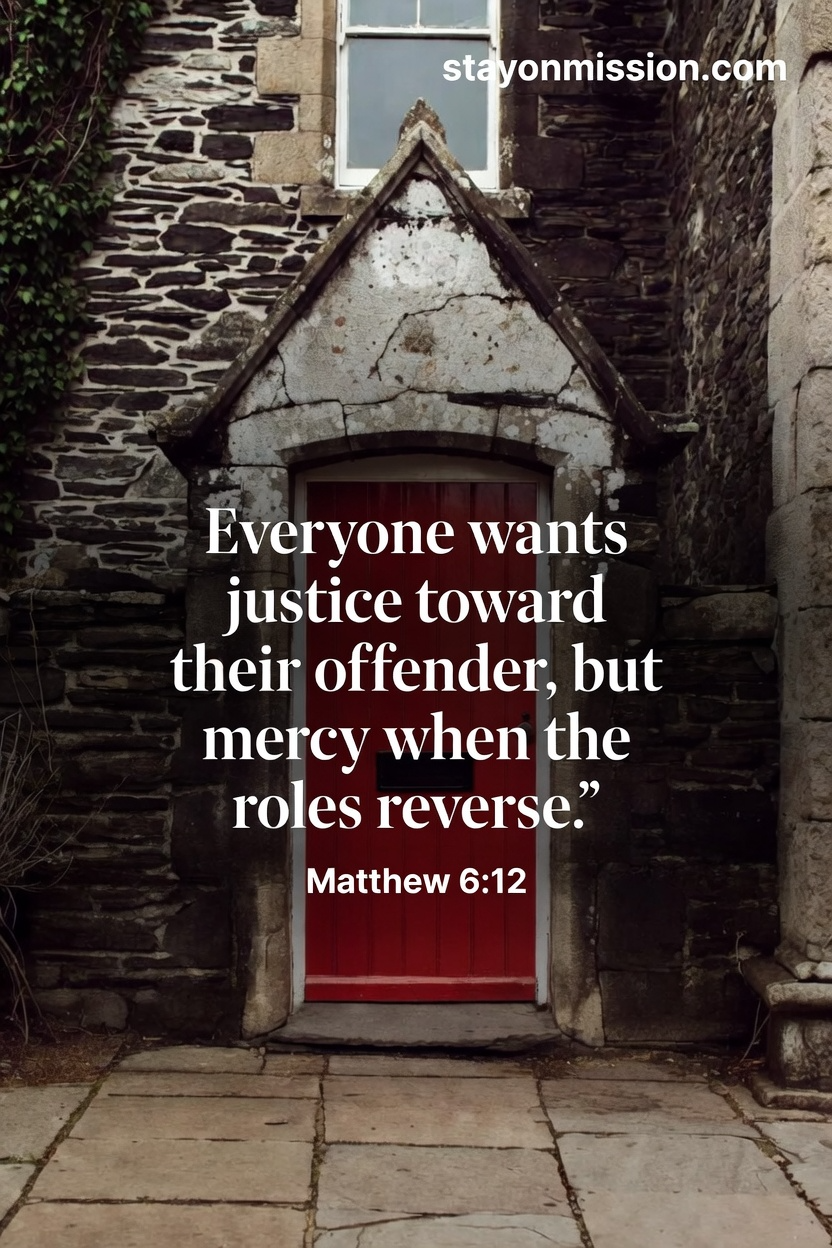
“And forgive us our debts, as we also have forgiven our debtors.” (Matthew 6:12, ESV)
No doubt you have been wronged by someone in your life. It might have been something trivial or extreme, but whatever it was, it cut, you bled, and a scar remains where the pain was created. In life, we will give and receive many scars, sometimes without realizing it and sometimes with full intent. Today’s verse carries several challenges as we enter our day, and at the center is one word: forgive.
The root word in Greek here means to send away, let go, release, discharge, or cancel. During Bible times, if you found yourself unfortunate enough to have accumulated debt, the owner of that debt could have you and your family imprisoned until it was repaid. That is the exact picture of our sin debt. We owe a penalty for the debt of sin we have earned. But unlike the repayment system of ancient times, our debt is against a holy heavenly Father, and the only release from this debt is the sacrificial gift of his Son, whose blood made the payment our own hands never could.
There is an old Scottish tradition to paint your front door red once you have paid off your mortgage. The symbolism was that your final payment had been made, and you were now out of the red. With the extra money from your next payment cycle, you would purchase an extravagant example to mark the victory. Red paint happened to be the most expensive available and served as that announcement.
Ambition poorly directed will eventually implode if the purpose is one’s own gain. Leaders often sacrifice personal time and financial security to develop those around them. One of the greatest rewards in leadership is watching someone you invested in rise past you. It is one of leadership’s truest delights. But far too often, a leader will find that a few of the ones they poured into were publicly loyal and privately something else entirely. Quiet betrayal through gossip, misaligned actions, and a loyalty that only ran as deep as their own advantage signals we’ve all seen. Jesus had Judas. You have likely had yours. The wound from that kind of debt is not small, and it does not heal on its own.
A grievance caused by another often carries deep emotional wounds and scarring that can cause real harm. These wounds draw out our own sinful responses. Forgiveness does not mean there can never be justice, but it does mean we allow the Judge to serve it. And how does he say he will serve it? At the same standard we set for others.
The same standard I set. Use on me. The same bitterness I hold. Hold toward me. The same wrath I have in my mind. Have toward me. The structure of this prayer is that we ask God to forgive us the way we forgive others. That is worth pausing on.
Everyone wants justice toward their offender but mercy when the roles reverse.
Moody knew what forgiveness was not before he told you what it was: “Forgiveness is not that stripe which says, ‘I will forgive, but not forget.’ It is not to bury the hatchet with the handle sticking out of the ground, so you can grasp it the minute you want it.”¹ C.S. Lewis drew the line even more precisely: “To be a Christian means to forgive the inexcusable, because God has forgiven the inexcusable in you.”²
The red door, the blood painted on the doorposts in ancient Egypt, and the nail-scarred hands of Jesus are all representations of the one who sacrificed himself for our debts. He was wronged by you, and he willingly set aside your rightful penalty to do so. That day on the cross, he cried Tetelestai, the same word a creditor would stamp across a paid bill in the ancient world. It is finished. The debt has been paid in full.³
Our wrongs and the wrongs done against us have been forgiven by the true judge. And so, we really only have two choices: we can carry a bag of grievances and act the victim all our lives, or we can live as we have been made — free.
Lord, help us today to live the free lives you have paid for. Help us to forgive freely and walk in your forgiveness daily.
Who in your life do you need to set free?
Who in your life are you still holding the verdict on?
Stay on Mission
FOOTNOTES
¹ D.L. Moody, Prevailing Prayer, Chapter 5. Also cited in Christian History, no. 25.
² C.S. Lewis, Essay on Forgiveness, in The Weight of Glory (New York: HarperCollins).
³ The Greek word tetelestai appears on ancient commercial papyri as a receipt stamp indicating a debt paid in full. For the connection to John 19:30, see John MacArthur, The MacArthur New Testament Commentary: John 12–21 (Chicago: Moody Publishers, 2008).


Leave a Reply