
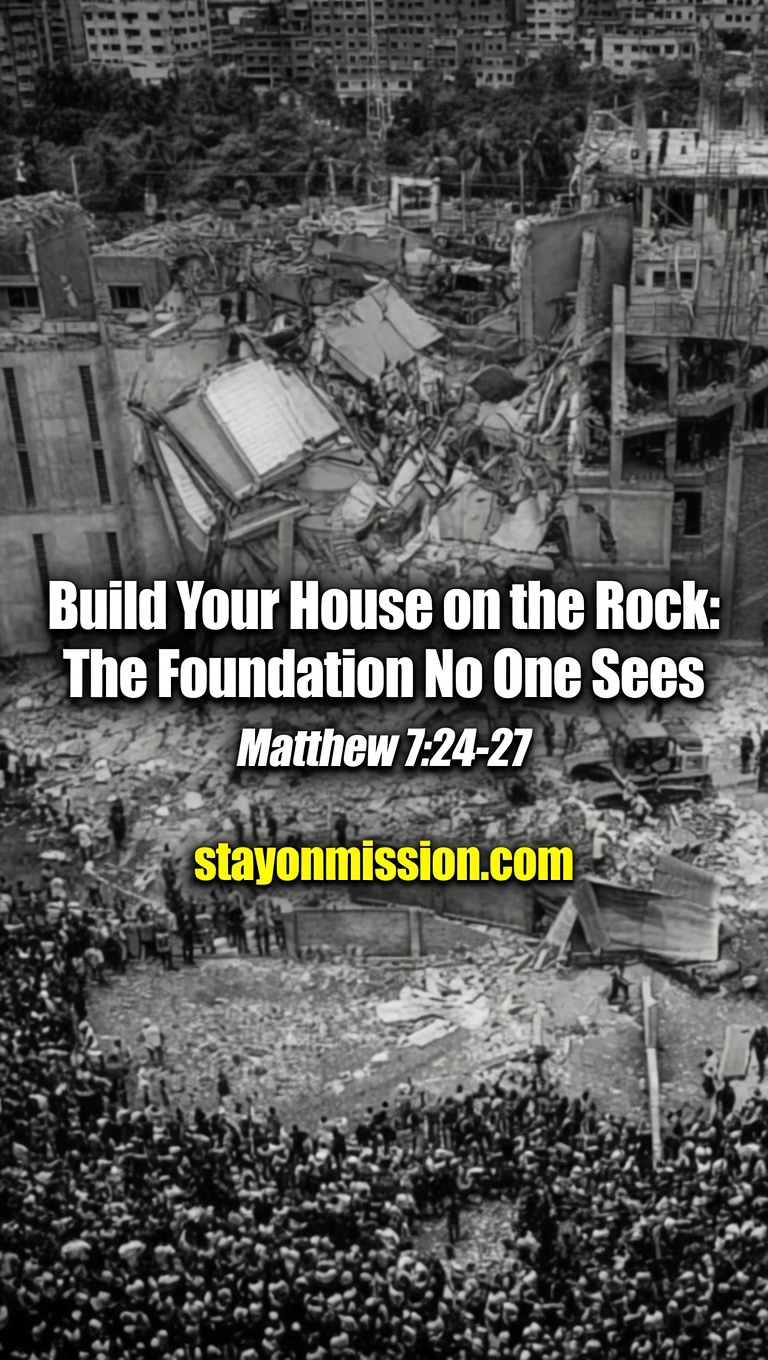
What it means to build your house on the rock, and how Matthew 7:24-27 reveals the foundation no one sees.”
On the morning of April 24, 2013, on the outskirts of Dhaka, Bangladesh, an eight-story building called Rana Plaza came down on the people working inside. The building had been raised on the bed of a pond. The building owner and contractors filled the pond in with sand and soil, opting for speed over a sturdy foundation on bedrock.
The structure was permitted at five levels, but over the years, three illegal floors were added, and heavy sewing machinery was installed. In the days before it fell, deep cracks opened across the walls, and the engineers who saw them said plainly that the building was no longer safe. The bank and the shops on the lower floors listened and stayed closed. The garment workers, most of them young women carrying entire families on less than two dollars a day, were ordered back inside the next morning to keep the orders moving. Within hours, the whole structure collapsed into roughly six hundred tons of concrete and steel, killing over eleven hundred souls, in what became the deadliest accidental building collapse of the modern age.
In his final appeal to the crowd on the mount, Jesus implores them to listen carefully to where they are building.
Matthew 7:24-27 “Everyone then who hears these words of mine and does them will be like a wise man who built his house on the rock. And the rain fell, and the floods came, and the winds blew and beat on that house, but it did not fall, because it had been founded on the rock. And everyone who hears these words of mine and does not do them will be like a foolish man who built his house on the sand. And the rain fell, and the floods came, and the winds blew and beat against that house, and it fell, and great was the fall of it.”
Jesus has already warned of the builders who travel on the wrong roads and even do miracles in His name, who will cry out in the day of judgment, “Lord, Lord,” yet will still hear, “I never knew you” (Matthew 7:21-23). That sets the stakes for everything that follows.
The house pictured here is your life. And Paul would later affirm, “The Rock was Christ” (1 Corinthians 10:4). A man can raise an impressive house of religious activity and never once set it on Christ. And that sets up our warning.
The parable does not discuss the structure being built, its ornate outward appearance, or its architectural efficiency. Those are what we see in buildings, structures, and even in men’s lives. It is what cannot be seen under the structure and what is happening in the mind when no one is looking that matters.
The contrast of these two, wise and foolish, presents a parallel also seen in Luke 6:48-49: “He is like a man building a house, who dug deep and laid the foundation on the rock. And when a flood arose, the stream broke against that house and could not shake it, because it had been well built. But the one who hears and does not do them is like a man who built a house on the ground without a foundation. When the stream broke against it, immediately it fell, and the ruin of that house was great.”
The difference between the two builders is the difference between the man willing to dig deep for truth and the man content with the superficial evidence. Proverbs 24:3 paints the same parallel between the wise and the foolish: “By wisdom a house is built, and by understanding it is established.”
In contrast, the foolish man builds his structure with knowledge of a potential storm but is lulled by its absence and apparent delay. His own experience tells him it never will come. The topography study he’s reviewed shows the 100-year flood risk is less than 1%, and so he says, “Looks good to me.” In life, this is the man who says an occasional glance is fine, one extra click won’t matter, a shortcut in this business deal is “just business,” or a missed day in the Word won’t hurt. This is the man who not only knows the truth but actively sets it aside and keeps building a life of falsehood, hoping the storm will miss him.
Two builders, two buildings, two different outcomes.
The two men had the same information, the same materials, and the same warning. The only difference was what each one did with what he heard.
“And the rain fell, and the floods came, and the winds blew and beat against that house.” The houses are our lives, and to these builders, a test is coming. It does not matter who you are or how high your house has been built, how glamorous and beautiful it may be outwardly. Hardships are inevitable, storms will rage, waters will deepen, and friends will betray you. The foundation will eventually be revealed.
Steve Farrar’s passion for men influenced and encouraged my walk tremendously. He warned, with Pauline force, that a simple drift would ultimately spell destruction, and in his own journey, he researched the fallout among pastoral leadership, finding an alarming number due to moral failures. It begs each of us to ask, if a man who has committed his life to the study and oration of truth can fall, then how dangerous is the ground we may stand upon if we are not prudent? I believe that is the teaching here for today.
The final charge of the Sermon on the Mount puts a hammer in your hand, the building plans delivered by the master architect Himself, with resources available from heaven itself. And now He lets you decide where to build. The builders in Bangladesh knew the site was not ideal; they heard the warnings about the impending disaster, but they ignored them, costing thousands of lives in return. You, too, stand at a crossroads with your own decisions. Perhaps you’ve been building for years on a foundation of sand, not on the truth Jesus has spoken in the preceding text. Or maybe you’re about to make a decision that nobody will see for a long time. Maybe you are in the midst of a personal storm right now.
Wherever you are today, be assured that everyone will face storms. Everyone. But only the lives built on the foundation of truth provided in God’s word will stand. And graciously folded inside the warning is the Rock that can never move. Christ is still the foundation and always will be, an offer open to you this very morning. And however many years you have spent building on sand, it is not too late to dig down through it and build again on Him. The wise man is not the one who never chose wrong. He is the one who hears the words of Christ today and does them.
Lord, help us recognize where we sit today. Help us see where we are building and heed the warning signs, the cracks in our lives, early, and avoid disaster. Provide for us wisdom and humility as needed to build a lasting life on you alone.
What has your life’s work been built upon?
What do you need to change today to thwart the impending storm?
Stay on Mission
Close in worship with Firm Foundation (He Won’t) by Cody Carnes.
Matthew 7:24-27 is the closing parable of the Sermon on the Mount, where Jesus contrasts two builders. The wise man hears Jesus’ words and does them, building on rock; the foolish man hears but does not obey, building on sand. When the storm comes, only the house on the rock stands. The lesson is that hearing the words of Jesus is not enough. A life that lasts is one that acts on them.
A: To build your house on the rock means to hear the words of Jesus and actually live by them, founding your life on Christ rather than on appearances or good intentions. Paul identifies that Rock as Christ himself (1 Corinthians 10:4). It is not about religious activity that looks impressive from the outside, but about real obedience that flows from knowing Christ as Lord.
A: In the parable, the rock is the firm foundation formed by hearing and obeying the words of Jesus. The wider New Testament names the Rock as Christ himself (1 Corinthians 10:4; Ephesians 2:20; 1 Peter 2:4-6). Building on the rock means building your life on Christ and his teaching, not on your own strength or a self-made sense of security.
A: Both builders hear the same words of Jesus, use the same materials, and face the same storm. The only difference is what each one does with what he hears. The wise builder obeys and digs down to the rock; the foolish builder hears and does not obey, building on sand. The dividing line is not knowledge or intelligence, but obedience.
A: Building on sand pictures a life founded on anything other than Christ and his words, such as appearances, good intentions, religious performance, or self-reliance. It can look fine in calm weather but cannot survive testing. In the parable, the house on sand collapses when the storm hits, and Jesus says “great was the fall of it” (Matthew 7:27).
A: The storm represents the trials, hardships, and ultimately the judgment that test every life. Jesus says the rain, floods, and winds beat against both the wise builders’ and the foolish builders’ houses alike. The storm does not decide the outcome; the foundation does. Everyone faces storms, but only the life built on Christ stands.
A: It means more than listening or agreeing. Jesus draws the line between hearing and doing, and the wise person acts on his words as the settled pattern of life. The doing is not what saves; it is the evidence that the foundation is real. James says it plainly: “be doers of the word, and not hearers only” (James 1:22).
A: It is about genuine versus false discipleship. Just before it, Jesus warns of people who did works in his name yet hear “I never knew you” (Matthew 7:21-23). The obedience of the wise builder is not how he earns the foundation; it is the proof that his life is truly built on Christ. The doing flows from knowing him, not the other way around.
A: It appears at the end of the Sermon on the Mount in Matthew 7:24-27, and again in Luke 6:46-49. Luke adds the detail that the wise builder “dug deep and laid the foundation on the rock” (Luke 6:48), underscoring the costly work of building on a true foundation.
A: You build on a firm foundation by hearing the words of Jesus and putting them into practice daily, founding your life on Christ rather than on appearances or self-reliance. In practice, that means obeying what you already know to be true, refusing to set Scripture aside for convenience, and rebuilding on Christ wherever you have been building on sand. It is never too late to dig down to the rock.
Sources
Scripture quotations are from The Holy Bible: English Standard Version (Wheaton, IL: Crossway Bibles, 2025): Matthew 7:24-27; Matthew 7:21-23; Luke 6:48-49; Proverbs 24:3; 1 Corinthians 10:4.
Music: Cody Carnes, “Firm Foundation (He Won’t)” (Capitol CMG / Sparrow, 2021).


Leave a Reply