
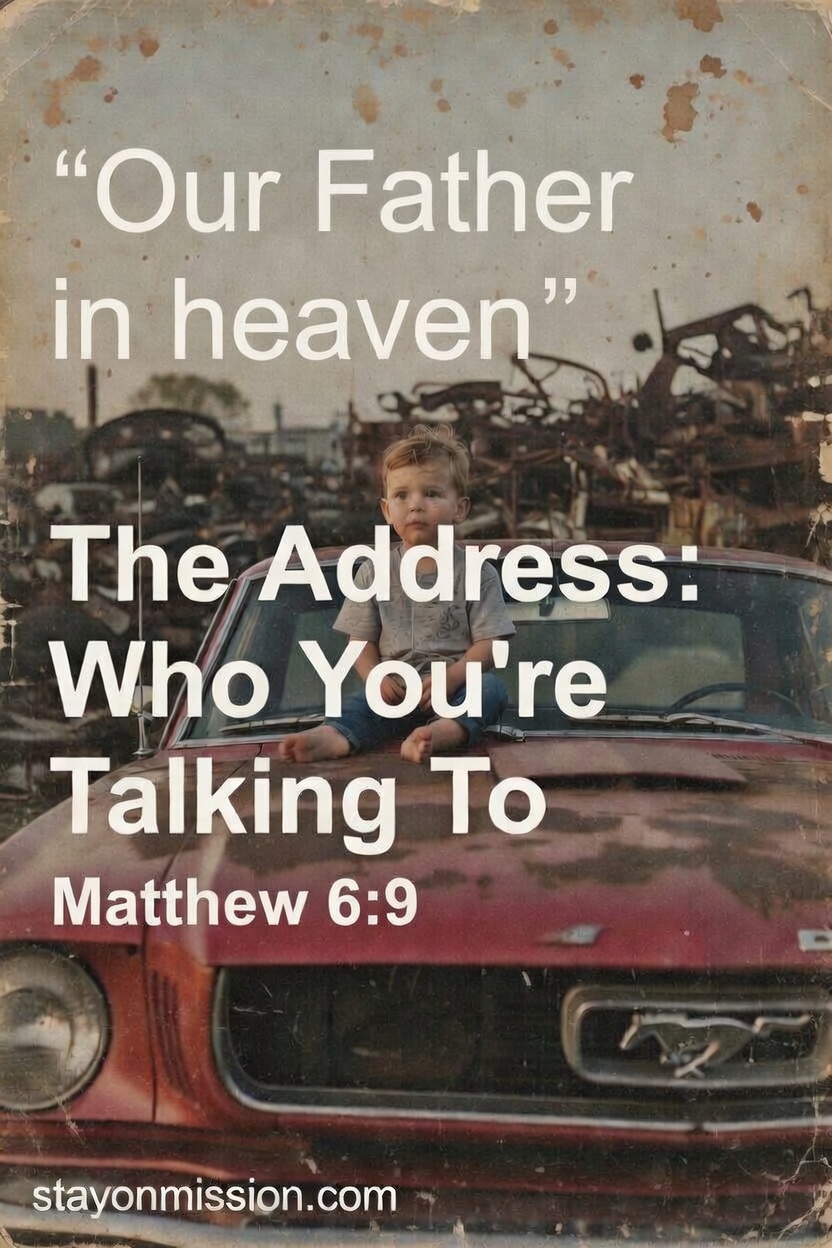
“Our Father in heaven, hallowed be your name. Your kingdom come, your will be done, on earth as it is in heaven. Give us this day our daily bread, and forgive us our debts, as we also have forgiven our debtors. And lead us not into temptation, but deliver us from evil.” (Matthew 6:9–13, ESV)
Everyone has a father. Set whatever yours was like aside for a moment, because Jesus is about to reframe the whole picture. He steps in here and moves his disciples away from showy, performative prayer toward a structure that can reshape not just how you pray, but who you believe you are praying to.
I was around two years old the first time my dad took me to a junkyard. I remember seeing a photo years ago. He was a car guy, always hunting down the rough ones and fixing them up, and wherever he went, his boy went with him. You do not have to remember something for it to have formed you. But that’s how fathers work. Examples, and mirrors whether they want to or not.
When my mother passed, it became apparent that my dad’s cognitive ability had been slipping for some years, quietly covered by her steady presence. As his dementia progressed, we shared what time we could together, each moment a fleeting one. When the time came to sell his house and move him, my brother and I decided to share that responsibility. We cared for him together for nearly two years until we finally made the tough call to move him into a memory care unit. He seems to be enjoying it, but I cannot escape the guilt of having him there, because I love him. Our roles had gradually reversed. He will always be my father, but it is my turn to show him the same care and support he had shown me for decades.
Your story is not unique. Millions of men are carrying some version of it, and millions more grew up without the story at all. Secular psychologists have a term for the way people perceive God based on their personal experience with their own father, called God representation or the paternal God image. One in four children in America grows up without a father in the home. Eighty-five percent of youth in prison come from fatherless homes.¹ The need for a present, engaged father is not sentiment. It is written into the data.
So why does Jesus use the word Father for the God of creation? The eternal, all-knowing, omnipotent, omnipresent, immutable, sovereign, self-existent God we call Lord could have been addressed as King, Ruler, or Emperor. Any of those titles would have fit the resume. But our finite minds cannot fully hold all that he is, and Jesus knows that. So rather than leaving us to grope after an incomprehensible sovereign, he names him in terms we can actually reach: Father. He is not minimizing God but giving us a relationship that is comprehensible.
No matter your experience with your own father, you know what it should look like. And if you have children of your own, you cannot help but feel it. Jesus makes the argument himself, later in the same sermon:
“Or which one of you, if his son asks him for bread, will give him a stone? Or if he asks for a fish, will give him a serpent? If you then, who are evil, know how to give good gifts to your children, how much more will your Father who is in heaven give good things to those who ask him!” (Matthew 7:9–11, ESV)
I have been thinking about this verse a lot lately. As I write this, both of my daughters are expecting our first grandsons. My wife was quick to pick her name but our family has been having a spirited debate about what the boys will call me. Papa. Chief. My personal favorite, Rodfather, jokingly. The vote is still out. But I can tell you this: whatever we land on, the moment I hold those boys for the first time, I will understand something about Matthew 7 that I could not have fully explained before. Because whatever I feel toward my grandsons, whatever instinct rises up to protect them and provide for them, will only be a shadow of something far greater. Jesus is pointing past every earthly father in the room, past the good ones and the broken ones alike, toward the only Father who has never once failed the child in front of him.
Our Father, in heaven.
We can all acknowledge the failings of our earthly fathers, and for the dads reading this, step into the weight of that responsibility yourselves. But do not stop there. Stand in awe of the one to whom you can actually pray. The sovereign God of the universe, the self-existent Creator who needs nothing and lacks nothing, has positioned himself toward you as a Father. Not a king waiting to be petitioned. Not a judge waiting to render a verdict. A Father. That is the door Jesus opened with the first two words of this prayer.
If your father was absent, abusive, or simply not what you needed, that word lands differently. Take comfort in what remains true regardless. The perfect Father created you in his image and has a plan for you. You were not a mistake. No human being is. You were made on purpose by a divine Creator who loves you and openly seeks a relationship.
Walk through the door.
What would it look like to approach the throne of your Father today, not as a subject, but as a son?
Where do you need to stop performing and start praying?
Stay on Mission
FOOTNOTES
¹ Fatherlessness data compiled from multiple sources. U.S. Census Bureau data (2025) places the number of fatherless children in America at 18.2 million, one in four, representing 33% of all U.S. children, up 25% since 1960. National Fatherhood Initiative, “Father Absence Statistics,” https://www.fatherhood.org/father-absence-statistic. Forty percent of all births in 2022 were to unmarried women, a fourfold increase from a generation ago; the United States leads the world in fatherless households. N-IUSSP, “America’s Single-Parent Households and Missing Fathers,” https://www.niussp.org/family-and-households/americas-single-parent-households-and-missing-fathers. Eighty-five percent of youth in prison, 71% of high school dropouts, and 85% of children with behavioral disorders come from fatherless homes. No Longer Fatherless, “Statistics,” https://www.nolongerfatherless.org/statistics. Sixty-three percent of youth suicides and 90% of homeless and runaway children come from fatherless homes; children from fatherless homes are four times more likely to live in poverty and twice as likely to suffer from mental health problems. Fix Family Courts, “Father Absence and Child Outcomes,” https://fixfamilycourts.com/divorce-child-custody-blog/single-mother-home-statistics.


Leave a Reply