
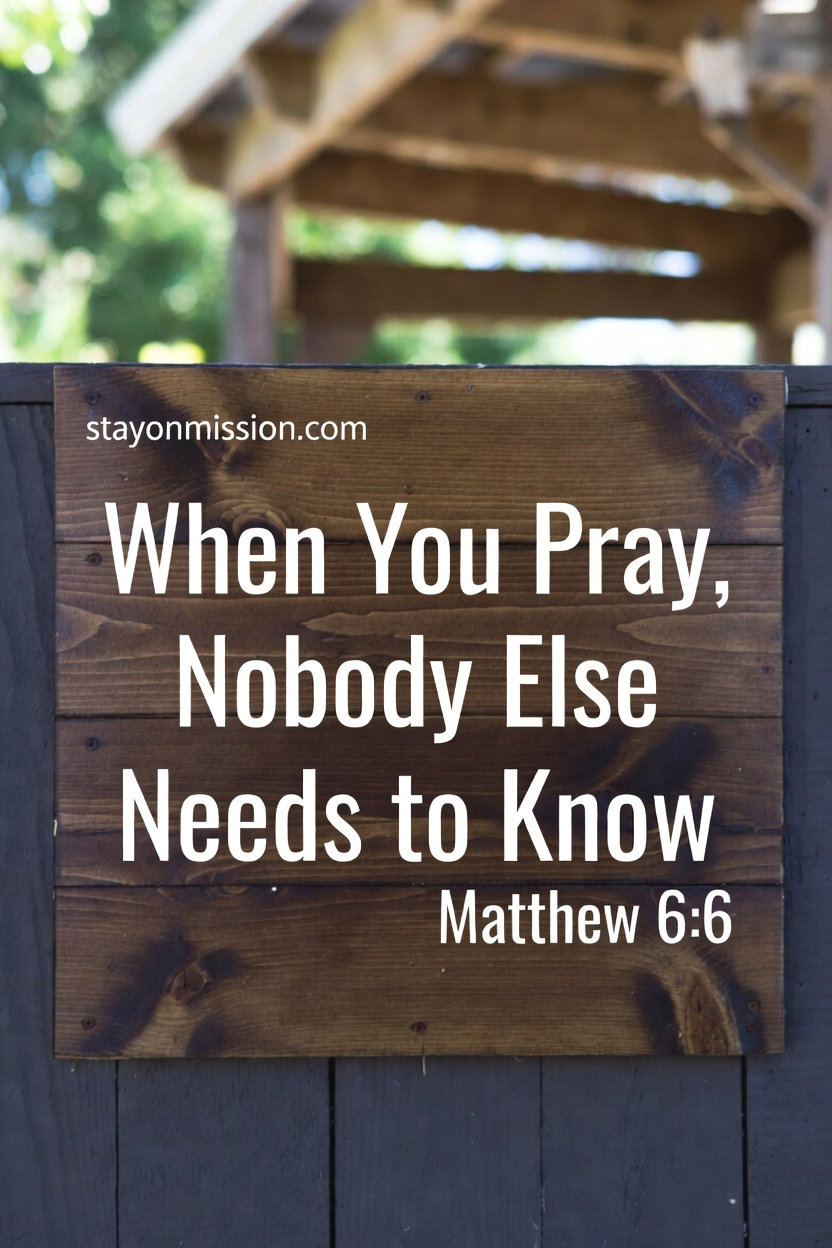
Matthew 6:5–8 (ESV)
“And when you pray, you must not be like the hypocrites. For they love to stand and pray in the synagogues and at the street corners, that they may be seen by others. Truly, I say to you, they have received their reward. But when you pray, go into your room and shut the door and pray to your Father who is in secret. And your Father who sees in secret will reward you. And when you pray, do not heap up empty phrases as the Gentiles do, for they think that they will be heard for their many words. Do not be like them, for your Father knows what you need before you ask him.2“(ESV)
A hupokritēs, the Greek word used here, was a stage actor who spoke from behind a mask. The word carried no moral weight in secular Greek, but Jesus reached into the culture and used what everyone already understood to name what was happening. These men were not simply prideful; they were playing a character. The mask was piety, and their audience was their fellow man. They were seeking attention, applause, and admiration from the crowd around them rather than communion with God above them.
Like those giving alms for the loud sound it would bring, so too were these men seeking to be seen and heard in their prayers. Jesus had set the wrong example before them, and now He begins to lay out something better: instructions on how we should approach prayer, leading toward the framework of the most spoken prayer known to man.
The approach. If we look back just a few verses to the Beatitudes, we find that the attitude behind our prayers should be a reflection and acknowledgment of where we actually stand. In Matthew 5:3–10, Jesus provides the playbook for our approach. We’re to be poor in spirit, mourning over our sin, meek in our walk, hungry for spiritual growth, merciful to others, pure in our motivation, peacemakers, and rejoicing even in persecution. The posture we carry into prayer matters deeply. We should approach the throne of heaven with careful hearts, understanding that while we have been given access, we come as the wretched who have been made welcome.
The location. In secret. Not the public prayers, but the private ones, the moments when you are genuinely seeking Him. Many years ago, I met a man who was searching for the Lord. After many coffees together and many conversations sharing the gospel, he called me one day and said, “I did it!” Awesome, I told him. What did you do? With excitement in his voice, he said, “I did what the Bible says to do. I went into my closet and asked God to reveal the truth to me, and I accepted Him as my Lord and Savior.” A rebirth happened that day, one that he and I will carry with us for the rest of our lives. All of it, in a closet, in secret, before the Father.
The words. We will get into the fuller understanding of the Lord’s Prayer in the coming days, but Jesus tells us here what prayer is not. It is not empty words strung together for effect, and it is not meaningless repetition offered in hopes that volume or frequency will move the hand of God. The Amidah, the Eighteen Benedictions, was prayed three times daily in Jewish practice, sometimes wherever a man stood when the hour arrived. The Pharisees, well aware of those prayer hours, could position themselves at a busy intersection when the time came. It was not coincidence. It was calculation.
Gentile prayer practice, particularly in Roman and mystery religion contexts, operated on a transactional model where the right words spoken the right number of times were believed to activate divine obligation. Quantity was power, and repetition was the currency.
Jesus cuts against all of it. Prayer is not incantation, and it is not mathematical. It was designed from the very beginning to be relational. Think about what it would look like to approach a trusted friend and simply repeat the same words to him over and over again. It would not only be unnecessary, but it would also be strange, because a real relationship does not operate that way. Neither does prayer. God already knows our thoughts, already knows our needs, already knows our reasoning, and is already prepared to answer according to His good mercy. We are not informing Him. We are communing with Him.
David understood this, and we will close with his words from Psalm 139:1–12:
“O Lord, you have searched me and known me! You know when I sit down and when I rise up; you discern my thoughts from afar. You search out my path and my lying down and are acquainted with all my ways. Even before a word is on my tongue, behold, O Lord, you know it altogether. You hem me in, behind and before, and lay your hand upon me. Such knowledge is too wonderful for me; it is high; I cannot attain it. Where shall I go from your Spirit? Or where shall I flee from your presence? If I ascend to heaven, you are there! If I make my bed in Sheol, you are there! If I take the wings of the morning and dwell in the uttermost parts of the sea, even there your hand shall lead me, and your right hand shall hold me. If I say, ‘Surely the darkness shall cover me, and the light about me be night,’ even the darkness is not dark to you; the night is bright as the day, for darkness is as light with you.”(ESV)
Perhaps the greatest lesson in all of this is that our prayers in private should remain there, because the man who is truly praying is mourning over the sin that lays him bare before the throne. There is no performance in that room. There is only a soul standing before a God who already knows everything. May God help us as we approach Him.
How can you be praying?
Where does your prayer life need improvement?
Stay on Mission


Leave a Reply