
Unburdened: Anxiety’s Antidote
Part 3: Seek First the Kingdom
Matthew 6:31-33
“Therefore do not be anxious, saying, ‘What shall we eat?’ or ‘What shall we drink?’ or ‘What shall we wear?’ For the Gentiles seek after all these things, and your heavenly Father knows that you need them all. But seek first the kingdom of God and His righteousness, and all these things will be added to you.2“
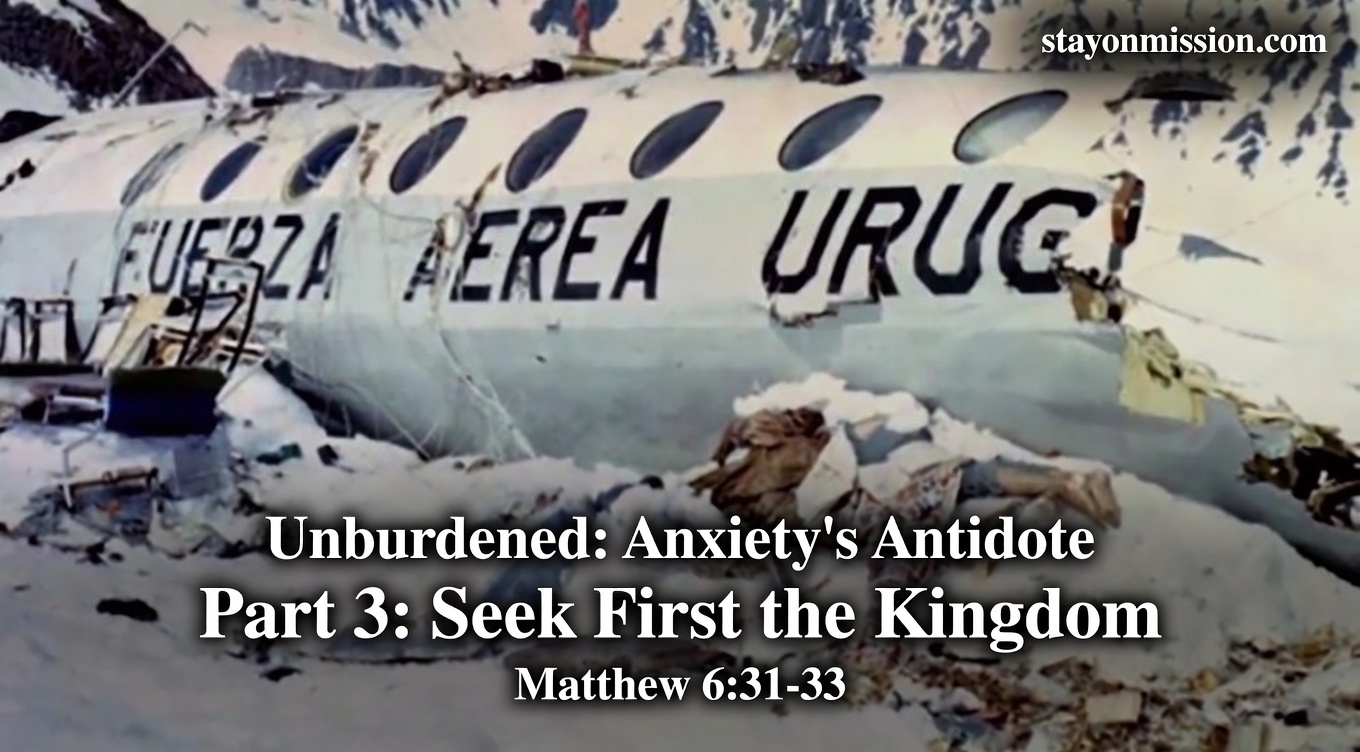
In 1972, a plane carrying the Uruguayan rugby team crashed in the Andes mountains during freezing conditions. In the early days after the crash, fear and anxiety began to consume the survivors. Food was almost nonexistent, water was scarce, and the future was more uncertain by the hour. Every thought captivating their minds was centered around the same questions:
“What will we eat?” “How will we survive?” “Are we going to die here?”
Jesus addresses a similar tension here in Matthew 6. Roman occupation had brought severe taxation and, for the Jews in particular, persecution. The crowd was not composed of the elite and wealthy; it was likely farmers, peasants, and fishermen who understood a subsistence economy and the anxieties that came with it.
Into this, He points backward with another “Therefore,” reminding the crowd that, despite their current conditions, despite the real-life pressures of providing food for the family tonight, the context of a loving heavenly Father did not change. The circumstances may have become more grim, and certainly humanity’s short-sightedness can do so. But in the same Sermon, He says, “Therefore.” He is calling the crowd to pause and reflect, to evaluate the situation with less emotion and more facts, in light of what has already been established as true.
You can hear Jesus’ loving, pastoral tone ring. “Your heavenly Father knows you need these things.” Why worry when He has this under control? The Greek word translated “be anxious” literally means “to be drawn in different directions.” Warren Wiersbe captures it plainly: “Worry pulls us apart.”¹
The rugby team was panicked. Loss of life was around them, hope dimmed with every moment, and emotions stole the very energy they needed to survive. Panic tempted them to scatter into the mountains searching desperately for rescue. But the Andes are merciless. One wrong direction in desperation would mean death.
Eventually, the survivors realized something profound: frantic searching without wisdom would destroy them. They had to stop, think clearly, conserve strength, and focus on what step to take first. Psalm 46:10 says it in four words: “Be still, and know that I am God.”²
During survival situations, like this rugby team, the first step one takes could mean life or death. Spiritually speaking, the first steps we take will determine the results of our lives. With a foundation already paid for, Jesus put a compass in front of the crowd and pointed it toward life, reminding them that the Gentiles seek the things that rust, that moths destroy, and that ultimately die. You, on the other hand, should seek first the only kingdom that will stand for all of eternity.
Forty-five souls boarded that flight in 1972. Two risked their lives and stepped toward finding a path to safety. After 72 days atop a freezing mountain, sixteen made it out alive.
Every day, you wake up and take a step in one of these two directions. Every day, you are either walking toward the kingdom or away from it. The compass of your life shows true, and your anxieties remind you where you are pointed.
What redirection in steps do you need to change?
What does this reveal about your anxiety today?
Stay on Mission
¹ Warren W. Wiersbe, Be Loyal: Following the King of Kings (Matthew). The BE Series Commentary (David C. Cook, 1980).
² (ESV)


Leave a Reply