
Represented in modern times, World War II has nearly been forgotten for its depth of good versus evil. Bloodied, torn, and under immense pressure to squelch the advancement of a regime bent on lies, the United States Army was called to perform. Commander General George S. Patton led the Third Army through the Lorraine offensive, where three months of rain had stalled every advance. On December 8, 1944, Patton picked up the phone and called his head chaplain, James H. O’Neill, with a single question. Did he have a good prayer for the weather?
O’Neill hesitated, citing the theological awkwardness of praying for clear weather in order to fight better. Patton cut him off. “Chaplain, are you teaching me theology, or are you the Chaplain of the Third Army? I want a prayer.”1
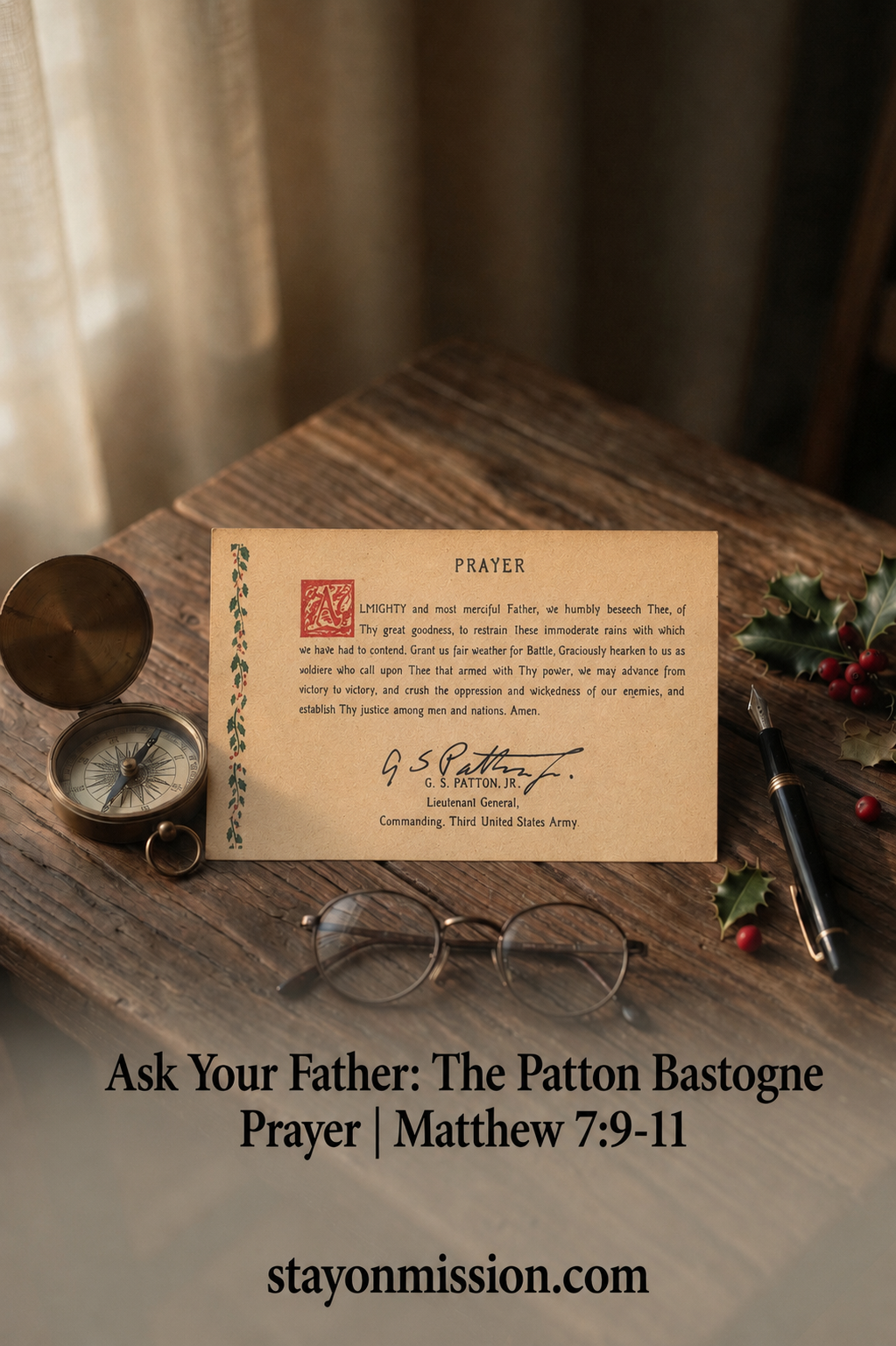
The chaplain wrote the following prayer, and 250,000 copies were distributed to the men.
Almighty and most merciful Father, we humbly beseech Thee, of Thy great goodness, to restrain these immoderate rains with which we have had to contend. Grant us fair weather for Battle. Graciously hearken to us as soldiers who call upon Thee that, armed with Thy power, we may advance from victory to victory, and crush the oppression and wickedness of our enemies, and establish Thy justice among men and nations.1
The exchange between Patton and O’Neill is preserved in Colonel Paul D. Harkins’s footnote to Patton’s published diary, War As I Knew It (1947), and in Chaplain O’Neill’s own first-person account written years later. The cards were distributed as the Battle of the Bulge raged. The weather in the days following the prayer being placed into the men’s hands, and the Third Army broke through to Bastogne, days later. Whatever a reader makes of weather and providence, the principle Jesus teaches in these verses is on display. Patton asked, the men asked, and the answer came.
The passage Patton was leaning into, whether he knew it or not, sits near the close of the Sermon on the Mount.
Matthew 7:9-11 (ESV)
“Or which one of you, if his son asks him for bread, will give him a stone? Or if he asks for a fish, will give him a serpent? If you then, who are evil, know how to give good gifts to your children, how much more will your Father who is in heaven give good things to those who ask him!”
It is difficult to say which passage of scripture or specific verse is my favorite, but this one I come back to frequently. Having four children, two of them sons, gives this verse a weight in my own life that I cannot read past. You can hear it in Jesus’s tone. While I would never suggest Jesus is using sarcasm, that’s what we would do. He sets the example of a caring father against the alternative of a cruel one. Recognizing that the audience of today could have had a different experience with their father, I invite you in to see the abundance to which He is speaking.
Have you ever been in a conversation where someone keeps repeating the same word? It gets your attention. Jesus uses the word “ask” five times across this section of His sermon. Not a mistake and not coincidental. Our Father in heaven is extraordinarily generous, providing beyond what we know to ask for. And that is the point.
He reminds them, “If you then, who are evil, know how to give good gifts to your children.” The word He uses for “evil” does not describe monstrous wickedness. It describes the universal fallen moral condition that every human father shares with every other. Jesus is not flattering His audience. He is being honest with them. He leans back into the Beatitudes as if to say, even though you do not have a pure heart and a settled moral compass, you still know how to give gifts to your own children. Imagine what a good Father, one of purest intent, who actually sees what you need rather than what you want, who has at His disposal more than earthly treasures, could give if you just ask, seek, and knock.
Jesus is not just preaching here. He is reasoning. If the lesser case, a fallen human father, clears the bar of giving good gifts to his children, the greater case, the unfallen Father in heaven, cannot fall short of that bar. The argument is closed, and He is settling it.
Ask.
I hope a real weight of understanding falls upon you with this text. Our prayer life reveals the depth of our understanding of God. Shallow prayer, shallow faith. But this section should also reveal an opportunity for the kind of boundless provision that is available in our Father if we just ask.
Lord, help me and everyone reading or listening to this today to grasp how good You are. Help us to ask for Your guidance, to seek You like a lost treasure, and to keep knocking until we look more like You.
Where do you need to begin asking today?
How does this change your prayer life moving forward?
Stay on Mission
Footnotes
- General George S. Patton to Chaplain James H. O’Neill, Third Army Headquarters, Nancy, France, December 8, 1944. Recounted in Colonel Paul D. Harkins’s footnote to Patton, War As I Knew It (Houghton Mifflin, 1947), and in Chaplain O’Neill’s own first-person account, “The True Story of the Patton Prayer” (Review of the News, 1971).


Leave a Reply