
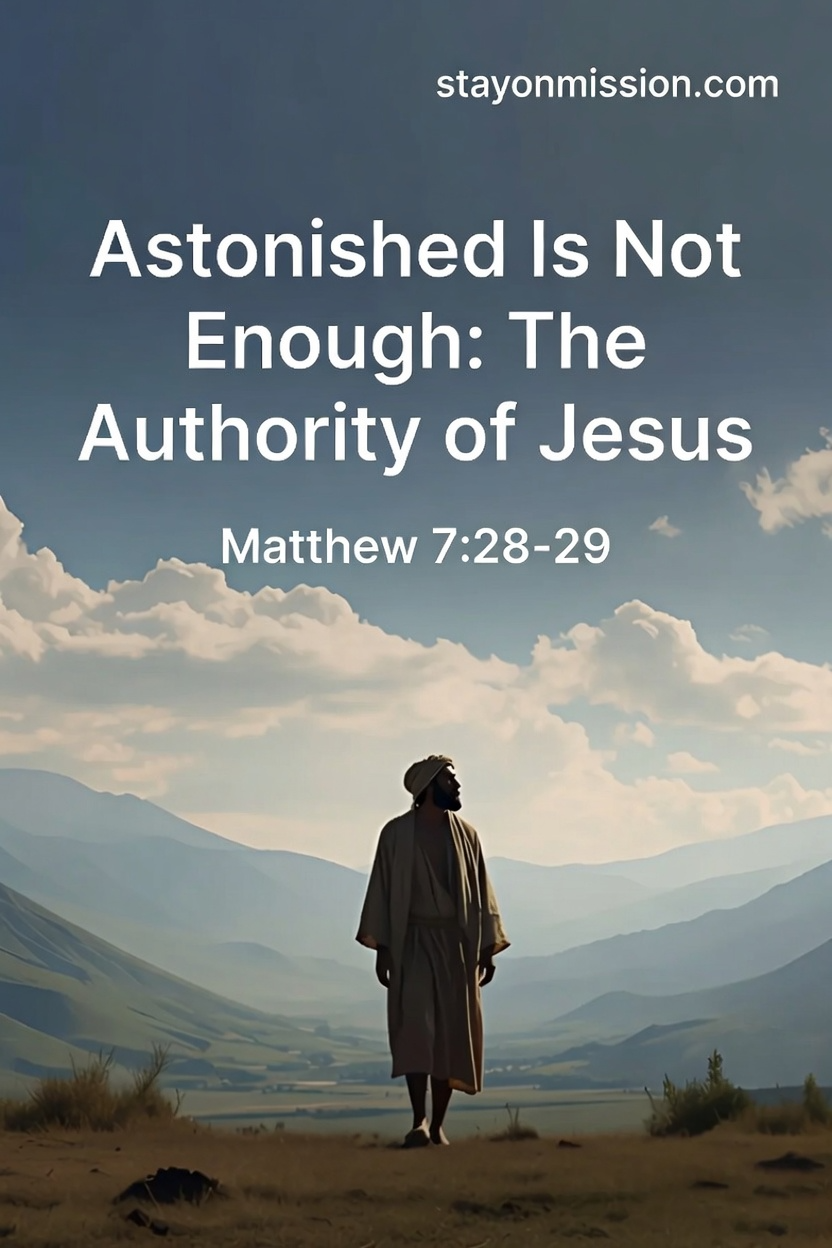
My name is Demetrius, and this is the story I can’t stop sharing about the day I met Jesus.
It was an ordinary day for me. I set out for the market early that morning with nothing on my mind but the errands of a normal day, the way a man walks a road he has walked so often that he no longer sees it. The sun had already melted the dew, the dust of the road lay warm on my feet, and I was turning over the small business of buying and selling that waited for me in the town. I was deep in thought when something in the distance drew my eyes off the path.
A large crowd had gathered on the slope of a hill, more people than I had ever seen assembled outside a feast, and they sat in the grass as still as one captured by what they were hearing; every one of them turned toward a single man. My first thought, I confess, was not a good one. I thought only that the gathering was a curious thing, and I half wished to stop, but then I reminded myself that errands do not run themselves and that whatever held those people wasn’t worth the distraction. So I set my face toward the town and walked on.
I had gone no more than a stone’s throw when the whole of the crowd drew breath at once, a single gasp lifting off the hillside the way a flock of birds lifts startled into the air, and the sound of it stopped me where I stood. I have turned that moment over many times in the years since, wishing I had heard the reason. A man can walk past a great many things in this life so long as he keeps his eyes fixed on the road ahead, but there are some sounds the road cannot account for, and that was one of them.
Perhaps, I told myself, I might hear only a little of what the man was saying. A little, and then on to the market.
I stood at the edge of the gathering, and within mere moments, I had forgotten my errands altogether. It was the authority and gentleness of the man that took hold of me first. He moved through the sacred writings of the Jews with such ease and such command, drawing one ancient saying up beside another as a builder sets stone upon stone, that I took Him at once for a man of high standing, a teacher trained in the great schools, a member of the ruling council perhaps.
But the longer I listened, the less that thought held. I had heard learned men teach before, in the markets and the colonnades of the cities, and every one of them leaned on some authority above his own. They quoted the masters who had taught them, and those masters had quoted the masters before, the way a son leans on his father and his father on the grandfather, each man borrowing the weight he carried. This man borrowed nothing. He would take up one of the old commands, the ones His people had carried since the days of their lawgiver, and He would say, you have heard that it was said, and every head would nod, for they had heard it all their lives. And then He would say, but I say to you, and He would reach straight past the command to the living root of it, and no master was named, no authority cited, nothing claimed but His own word.
I had spent my life under men who gave orders and men who took them, and I knew the sound of borrowed authority and the sound of the real thing. It was not enough, He said, for a man to keep his hands from murder while the hatred still lived in his heart, for there the murder was already done. It was not enough to keep the letter of a vow when a man’s plain word should have been bond enough. And then He said the thing that stopped the breath in my chest, that a man was to love his enemy and to pray for the very one who struck him, which in the world I came from was not wisdom but madness. No teacher I had ever heard would dare to amend the sacred law of his own people on nothing but his own word. Either the man on that hill was raving, or He spoke with a right that was truly His own, and I did not yet know which. I only knew I could not walk back to the market as though I had not heard it.
A little while longer, I thought. Finding a place in the grass, I sat and turned to the man beside me, asking quietly, “Who is this that teaches so?”
“I am not certain myself,” he said. “He calls Himself Jesus, of Nazareth. They say He has been healing the sick all through Galilee, and that signs follow Him wherever He goes.” He studied me a moment. “You are not from here.”
“No. I was bound for the market. And you?”
“The same. I meant only to pass by.” He gave a small, bewildered laugh, the laugh of a man who cannot quite explain himself to himself. “Something in the crowd, and in His teaching, took hold of me, and I have not been able to leave.”
So we sat together, two travelers who had each meant to be somewhere else, and we listened.
I cannot tell you all that He said, though I have tried ever since to hold every word of it. I can tell you what it did. As He spoke, something in my chest began to burn, conviction and joy braided so tightly together that I could not have pulled the one from the other if I had tried. All my life, I had labored to be a good man. A good father to my children, a good husband to my wife. My own father had taught me to rise early and work hard and owe no man, and I had done these things and counted myself decent for the doing of them. But I had never once heard wisdom of this depth, nor truth spoken with this kind of unanswerable weight. Looking back on it now, I think my soul had been a dry well for as long as I could remember, lowered day after day into the dark and drawn up empty, and that His words were the first rain ever to fall into it. I had not known until that morning how thirsty I was.
When at last He finished, I sat in the silence with my mind reeling, and what astonished me almost as much as the teaching was the look on the faces all around me. The same wonder, the same trouble, the same unspoken question passing from one man to another like a wildfire along a dry field. Who is this man? From where does such authority come? And where might we hear more?
I reached the market in the end, though far later, and not at all the same man who had set out for it.
The body keeps its habits even when the soul has been overturned, but I bought and sold that day as a man does in a dream, and as I walked the long road home in the failing light, I turned His words over and over the way a man turns a strange coin he has found on the road and cannot account for. I was no Jew. I had no faith to speak of and no god I had ever truly called my own, for the gods of my fathers had always seemed empty to me.
I wish I had heard the whole of what he taught that day and understood more clearly. But I did understand something. I knew deep down that I could not let such words pass through me and leave me as I had been. I remembered Him speaking of truths I had always felt but never comprehended. He spoke of the one true God as a Father a man could actually know, the way a child knows the one who raised him. He said that no father among us, if his own son asked him for bread, would set a stone in the boy’s hand instead, and that the Father in heaven is kinder by far, giving good things to the children who ask Him. I sat there undone, certain He was speaking to no one in that crowd but me. It was as though He knew my whole life, and the very worry that had walked the road with me that morning, the gnawing fear over whether I could put enough bread on my own table for my family.
Then He began to draw toward His close, speaking of trees and the fruit that betrays them, and of a narrow gate that few would ever trouble to find, and at the very last of two men and two houses, the one built upon rock and the one upon sand, and the storm that came for them both. He had ended on a hard word, a word I was not ready to hear that morning, though I think now I am only beginning to understand it. Everyone who hears these words of mine and does not do them, He said, will be like a foolish man who built his house on the sand.
I do not fully know what happened to me on that hillside. I know only that the man who reached his own door that night was not the man who had set out for the market that morning. I gathered my whole household around me and told them everything, every saying I could call back to memory, of this teacher, this Jesus, this one the people were beginning to call the Messiah. And they were astonished, as I had been astonished. And before we slept, we resolved together that when the sun rose, we would go and find Him.
A simple errand to the market, and on the road, I found my Lord.
“And when Jesus finished these sayings, the crowds were astonished at his teaching, for he was teaching them as one who had authority, and not as their scribes.” Matthew 7:28-29 (ESV)
The traveler on that hillside is not found in the pages of Scripture. He is an invention. But he is not a lie, for he stands in the place of the countless ordinary people who walked out to that hill for one reason and came down from it changed, and in the place of every reader who has ever met the words of Jesus while on the way to somewhere else.
What Matthew records in these two verses is the verdict of the crowd, and it is the lowest verdict a person can reach about Jesus and still be honest. They were astonished by His authority. Hopefully, you were at the first reading as well. This is the very thing our traveler could not stop turning over. That is what struck the crowd to silence, and it is the question the whole Gospel exists to answer. Who is this, that He teaches the law of God as though it were His own to give?
That morning, Jesus brought to a close the longest sermon of His ministry, a ministry that would run little more than three years before carrying Him to His crucifixion, His burial, and His resurrection. To the crowd that heard Him then, and to everyone who will listen and yield today, He says the same two words He once said to fishermen by the sea. Follow me.
The traveler heard them and could not let them pass.
What will you do next?
Stay on Mission
They were astonished because Jesus taught on His own authority rather than by citing other teachers. The scribes of His day taught by quoting the rabbis before them, but Jesus reached past the received tradition and spoke as though the law were His own to give. Matthew records that He taught with authority, not as their scribes (Matthew 7:29, ESV).
The scribes carried borrowed authority, and the weight of their teaching came from the chain of teachers they could cite. Jesus carried inherent authority. He named no master above Himself and corrected the tradition on His own word, which is why the crowd sensed they were hearing the source of the law rather than another interpreter of it.
Matthew 7:28-29 closes the Sermon on the Mount, the longest recorded sermon of Jesus. The passage shows that astonishment is the lowest honest response to Him. The same authority that amazed the crowd still calls every hearer past admiration into obedience, to follow Him rather than simply marvel at His words.


Leave a Reply