
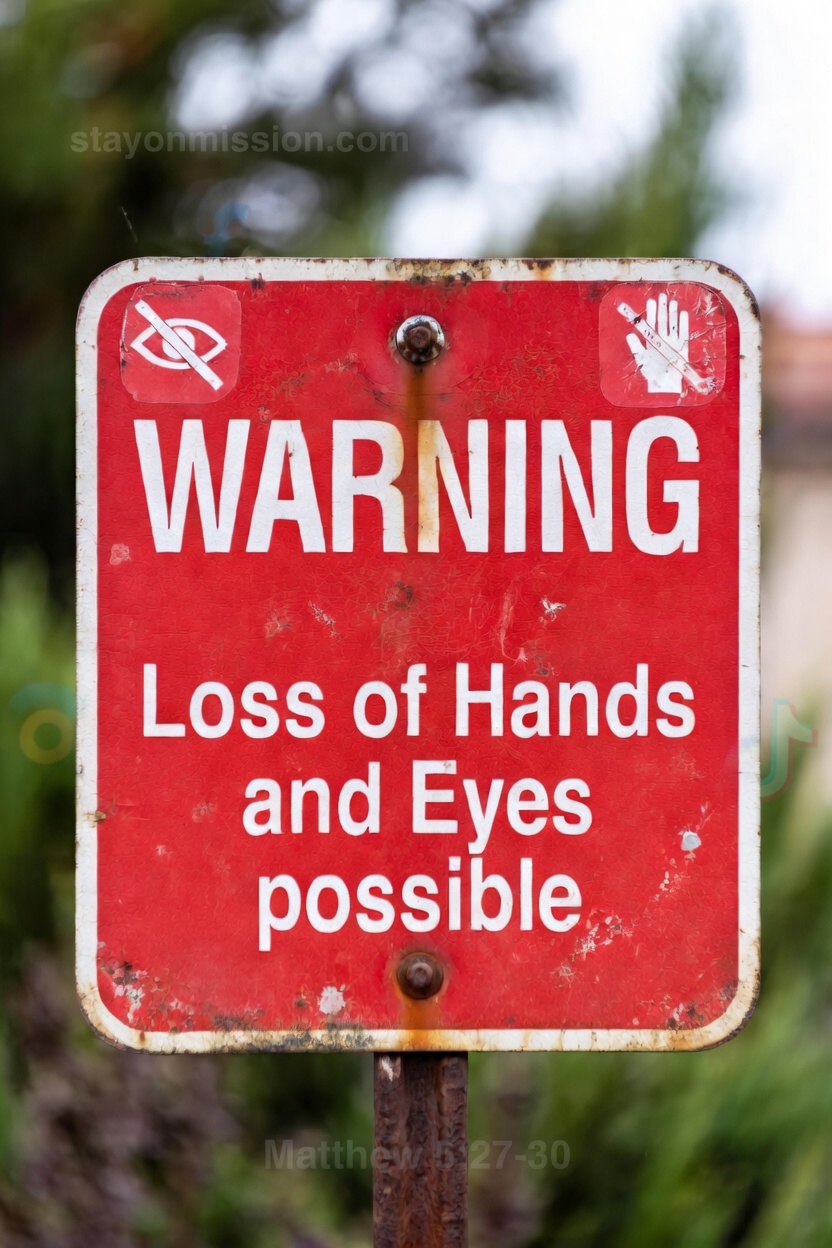
Matthew 5:27-30 “You have heard that it was said, ‘You shall not commit adultery.’ But I say to you that everyone who looks at a woman with lustful intent has already committed adultery with her in his heart. If your right eye causes you to sin, tear it out and throw it away. For it is better that you lose one of your members than that your whole body be thrown into hell. And if your right hand causes you to sin, cut it off and throw it away. For it is better that you lose one of your members than that your whole body go into hell.2”(ESV)
This passage is the second of six antitheses in Matthew 5:21–48, where Jesus follows the pattern “You have heard it said… but I say to you.” Here He turns to adultery, and shows it can begin with even a simple look.
The Pharisees would have known the seventh commandment and taught this commandment as a prohibition against the physical act of adultery alone. Jesus corrects that with full authority: the act of adultery is already committed the moment lustful intent takes root in the heart.
The construction in the Greek here carries the sense of deliberate, intentional desire. This is not the unbidden flash of attraction. Those, unfortunately, are all around us. It is the gaze held, the imagination engaged, the will directing the eyes toward what is forbidden. Jesus is condemning purposeful, cultivated desire, not the fact of temptation itself.
MacArthur nails it: “It is not lustful looking that causes the sin in the heart, but the sin in the heart that causes lustful looking. The lustful look is but the expression of a heart that is already immoral and adulterous. The heart is the soil where the seeds of sin are embedded and begin to grow.”1
The eyes follow the heart. Nobody stumbles into lust the way they stumble over a root on a dark trail. They actively walk toward it. Holding the gaze, entertaining what you know you should refuse. This is someone who sees it, knows what it is, and decides to stay.
This was never fully about the act. It is about the heart that wants it. That decision is the sin.
Unlike David, the rooftop is now a screen, a scroll, a click made in a dark room where no one can see. The architecture of lust has never been more accessible, more aggressive, or more normalized. But Jesus does not grade on a cultural curve. His standard does not adjust because the temptation got easier to find.
And his advice is not mild to say the least. He offers a knife. Tear it out. Cut it off. Whatever is feeding the sin, remove it. MacArthur puts this just as directly: the godly man “plans to avoid lust-satisfying situations whenever possible and to flee from them when unavoidable.”2
This is not behavior modification. This is amputation. Jesus mentions the right eye and the right hand because those are the dominant ones, the most valued. He is saying cut off even the things that feel essential if those things are the pathway to sin. No exception. No negotiation.
The word He uses for hell is Gehenna, referring to the Valley of Hinnom, a trash pile outside of Jerusalem, that some say would constantly be on fire. A fire never went out. He is telling you exactly where the road to that look ends. A burning trash heap of disaster.
There’s an old quote worth stating here.
“Sin will take you farther than you want to go, keep you longer than you want to stay, and cost you more than you want to pay.”
Guard your eyes. Guard your heart. The two are not as separate as you think.
What are you lusting after in your heart?
Where do you need to stop letting your eyes wander?
What needs to be cut out or cut off today?
Stay on Mission


Leave a Reply